The Gnostic Archive

The Gnostic Archive

γνῶσις — gnosis, “knowledge”

“Knowledge is a kind of remembrance.”

— After Plato

It sounds like a line lifted from an ancient manuscript, but its home is Plato — his doctrine of anamnesis in the Meno and Phaedo: that learning is the soul recollecting what it already knows. Some Gnostic authors adapted Platonic ideas of the soul and knowledge into stories of spiritual return.

A shared space to explore Gnosticism — its mysteries, its wisdom, and what it means for us.

Enter the Archive
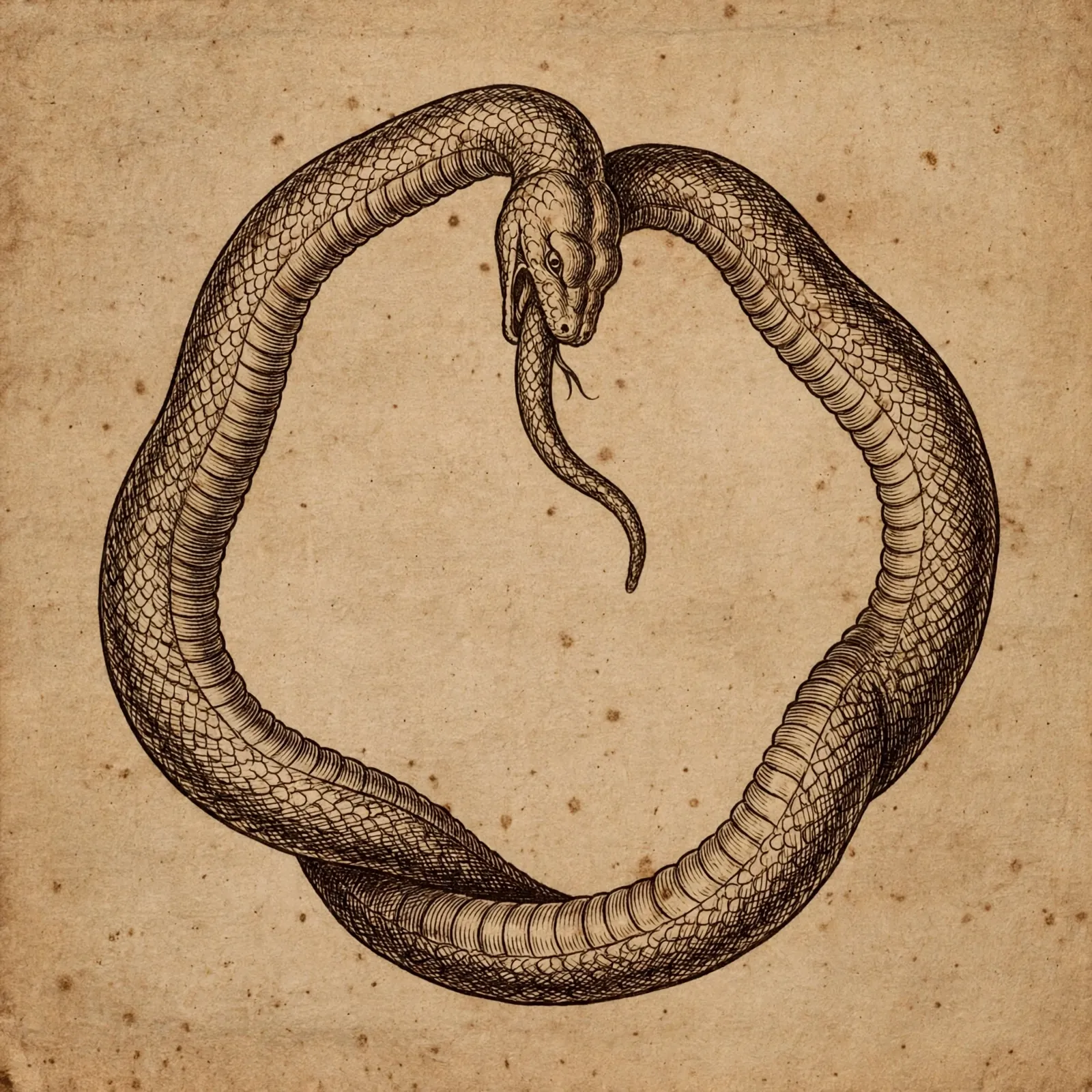
The Ouroboros — an engraving of a serpent eating its own tail, forming a perfect circle

The Ouroboros — “One is the All,”
the emblem of this archive

Gnosticism is not one religion, and it never was. It is a modern umbrella term — coined in the 17th century by the English philosopher Henry More — for a cluster of related religious and philosophical movements prominent in the Greco-Roman world of the 2nd century CE. Many of these movements explored a recurring story and promise: a hidden God beyond this world, a lesser creator who made it, a spark of divine light trapped in human bodies — and salvation through gnosis, a direct, revelatory knowing of where that spark came from and how it gets home.

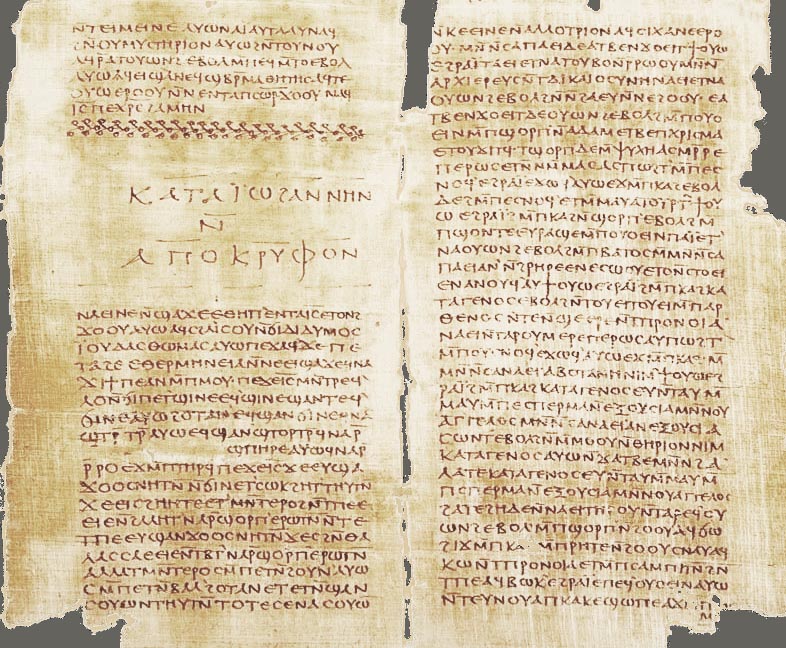
Opening pages of the Apocryphon of John in Nag Hammadi Codex II, showing dense columns of Coptic script on aged papyrus
Nag Hammadi Codex II, open at the Apocryphon of John — the fullest surviving Gnostic creation myth, and the most-copied text in the library found in Egypt in 1945. Photograph: public domain, via Wikimedia Commons; the manuscript is held by the Coptic Museum, Cairo.
17th centuryHenry More coins “Gnosticism” — a modern label, rather than the name of one ancient religion.
2nd c. CETeachers and circles flourish — Basilides, Valentinus, and groups now called Sethian — mostly in Alexandria, Syria, Egypt, and Rome.
c. 180 CEIrenaeus of Lyon publishes Against Heresies, the work that defined these groups as heresy.
Dec 1945A farmer near Nag Hammadi, Egypt, unearths 13 codices containing 52 tractates, including duplicates — a remarkable window into ancient religious thought.

The rooms of the archive

New to Gnosticism? Begin with The Story, then explore the concepts or compare the schools. Follow a question, a symbol, or a text wherever it leads.

The Story

The myth underneath everything else, told straight through in eight steps — the Monad, Sophia’s fall, the Demiurge’s world, and the soul’s ascent home.

Cosmology & Concepts

The Monad, Pleroma, and beyond.

Study & Learning

Compare Sethian, Valentinian, and Basilidean teachings.

The Library

Texts, translations, and historical sources.

More Stories from the Texts

Eight smaller stories from the library — Norea burns the ark, the laughing Saviour, Thunder: Perfect Mind, the Hymn of the Pearl, and more.

Lasting Influence

Where the old ideas surface again in later centuries — Mandaeism, Jung, modern revivals, and popular culture

Unresolved Questions

The research details that remain unresolved, marked plainly.

Section 1 · The Story

The story the Gnostics tell

This is the myth underneath almost everything else on this page — told straight through, in order. No single text tells it exactly this way; the Apocryphon of John comes closest. Valentinian, Sethian, and Ophite versions change the names and the blame, but the shape holds: perfection, a mistake inside heaven, a flawed world built by a lesser god, a piece of heaven trapped inside human beings, and a messenger who wakes it up.

How to read this: Gnostics did not all read this story literally. For many teachers it was also a map of the soul — Sophia's fall is what happens in every person who reaches for knowledge alone, and the ascent past the archons is what waking up feels like from the inside.
  1. Before anything, there is a God no one can describe

    Before time, matter, or angels, there is the Monad — the One, the Invisible Spirit, the Depth. He is not the God of Genesis. He did not make the world, he does not judge it, and he cannot be named, pictured, or reached by prayer alone. He is complete, silent, and at rest.

    Out of that rest, thought overflows. The first thought is Barbelo — a feminine power, called Mother, First Thought, the image of the invisible. From her, and in pairs, come the aeons: living divine qualities — Thought, Foreknowledge, Incorruptibility, Truth, Life, Church, Humanity, and others. Together, all of them are the Pleroma, the Fullness. Nothing is missing there. Nothing hurts there.

  2. Sophia reaches — and something is born wrong

    The youngest aeon is Sophia, Wisdom. In the Sethian telling, she wants to create as the Father creates — but she acts alone, without her partner and without the Father's consent. What she produces is not fullness. It is a misshapen, lion-faced, serpent-bodied child, born in ignorance.

    Ashamed, she hides him in a cloud of light outside the Pleroma so the other aeons will not see him. She names him Yaldabaoth. In the Valentinian telling the tone is softer: Sophia's passionate longing to know the Father directly overflows, and that overflow — her suffering, ignorance, and grief — becomes the raw material from which everything below will be made.

  3. Yaldabaoth steals power and builds a world

    Yaldabaoth does not know where he came from. He has inherited real divine power from his mother — but he does not know that either. Looking around at emptiness, he concludes he is alone, and he declares it: “I am God, and there is no other god beside me.” The texts treat this as the original lie — not malice at first, but ignorance mistaking itself for supremacy.

    He creates helpers — the archons, rulers — and organises a cosmos in imitation of the Pleroma he has never seen: seven heavens, thrones, powers, and firmaments. Then he and his archons decide to make a human being in the image they once glimpsed reflected on the waters — the image of the true, perfect Human from above.

  4. Adam is made — and the theft is reversed

    The archons build Adam's body piece by piece, each one making a part — but the body lies inert. It cannot stand. Then, by a trick from above, Yaldabaoth is persuaded to breathe his own spirit — the power he stole from Sophia — into Adam's face to bring him to life.

    It works — and it ruins him. The power passes out of the Demiurge and into Adam. Now the human being carries the divine spark, and Adam's mind is brighter than his makers'. The archons see it at once: the creature they built to serve them contains something higher than they are. Terrified, they throw him down into matter, into the lowest region, and try to keep him asleep — in ignorance, in toil, in a paradise where he is forbidden the one tree that would tell him the truth.

  5. Eve, the serpent, and the first act of gnosis

    This is where the Gnostic retelling of Genesis reverses the familiar moral. The command not to eat from the Tree of Knowledge comes from the jealous Demiurge. The serpent — and in some texts, Eve herself in her spiritual form, or Christ — urges them to eat anyway.

    When Adam and Eve eat, their eyes open. They see that their creators are animal-like, ignorant, and afraid. They see they are naked — not just unclothed, but stripped, trapped in bodies made by lesser powers. In the orthodox story, eating is the Fall. In this story, eating is the first awakening — and being expelled from paradise is the archons trying to stop a second one, at the Tree of Life.

    “Then I entered into the midst of their prison, which is the prison of the body. And I said: Whoever hears, let him arise from deep sleep.”
    — The revealer's call, in the Apocryphon of John tradition
  6. History is a prison with generations

    After Eden, the archons tighten their grip. They flood the world when humanity grows too knowing (Noah is warned by Providence). They bind human beings with fate — heimarmenē — the machinery of the stars and planets, so souls forget their origin and mistake the prison for home. The archons violate Eve, and Cain's violence follows, in some of the darkest passages of the Apocryphon and the Hypostasis of the Archons — texts that insist the violence in scripture attributed to “God” was really the archons' work.

    But the seed survives. Through Seth, Adam's third son, a lineage — the seed of Seth, the “immovable generation” — carries the spark down through history, never quite extinguished.

  7. A messenger comes down — and he comes speaking

    The Pleroma does not leave the spark trapped. Again and again, a revealer descends through the heavens, disguising himself from the archons, taking a form they cannot seize. In Christian Gnostic texts that revealer is Christ — not primarily a sacrifice for sins, but a teacher from beyond the Demiurge's world who comes to remind human beings who they are.

    And crucially, he comes talking. Many of the books the Gnostics treasured are not stories about Jesus at all — they are collections of his words, dialogues with him after the resurrection, or secret teaching he is said to have given to one disciple alone. His message in them is not “believe this about me.” It is: remember where you came from. You are not from here. The god who made this world is not the highest God. Wake up. That remembering — gnosis — is itself the rescue beginning. The next section stays inside this step of the story, because for the Gnostics, Jesus's words are the rescue in action.

  8. Death is an ascent past guards

    For the awakened, death is not judgment — it is escape. The soul rises through the seven heavens, and at each level an archon demands an account. The texts give the soul words to say — declarations of origin: in effect, I come from the Father. I was not made by you. You have no claim on me.

    Those who do not know are turned back — reincarnated, in some systems, into another body, another round of forgetting. Those who know pass through, shed the garments of matter one by one, and re-enter the Pleroma. Sophia herself is restored to her place, her error corrected, her partner restored to her. The Fullness is full again — and nothing that was lost is lost forever.

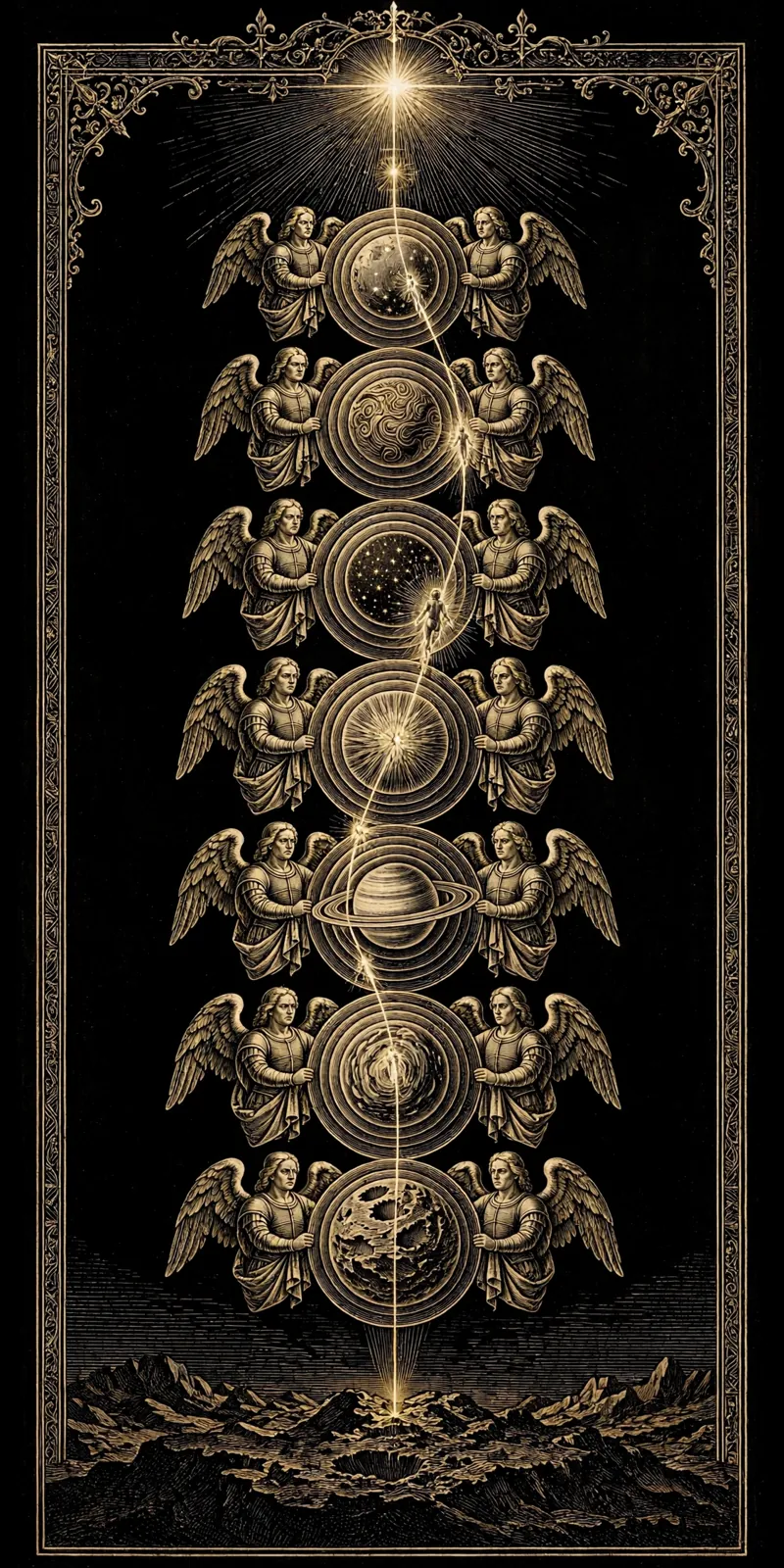
Engraving in gold on black: a soul rises as a thread of light through seven planetary spheres, each held by a pair of winged archons, from the dark earth at the bottom to a radiant star at the top
Plate I · The Ascent A modern engraving in the antique style, drawn for this guide: the awakened soul rises as a thread of light through the seven spheres, each guarded by its archons, from the dark earth below to the light above — the journey home that step 8 describes.

That is the whole arc: light overflows, wisdom errs, ignorance builds a world and calls itself God, the stolen light ends up hidden inside human beings, and salvation is not being forgiven by the maker of the prison — it is remembering you were never really his.

Section 2 · Jesus in the Ancient Texts

What Jesus says — and how the Gnostics heard it

These books present teachings attributed to Jesus; that attribution does not establish that the historical Jesus spoke them. A large share of the library the Gnostics kept is not myth about aeons at all. It is Jesus talking: sayings collected with no story around them, long dialogues after the resurrection, and private teaching said to have been given to Thomas, to Mary Magdalene, or to John when the other disciples were not there. The Gnostics did not just add a new story around Jesus. They read his words as the key that unlocks the story — and they heard those words very differently from the church that kept the four Gospels.

About the “books that were taken out”: it is messier than one removal. There was no single moment when a council voted these books out of a finished Bible. The canon formed slowly, over centuries, as churches argued over which books to read publicly. Athanasius's letter of 367 CE is the first surviving list that matches the 27-book New Testament exactly — and books not on lists like his were copied less, then lost, then in Egypt buried, until Nag Hammadi brought many of them back in 1945. Some had also circulated for a long time as respected scripture in their own communities before they fell out of the mainstream. “Left out as the canon closed” is closer to what happened than “taken out in one act.”

The books that are mostly Jesus talking

Gospel of Thomas — 114 sayings, no story

Thomas opens by telling you exactly what kind of book it is: “These are the secret sayings which the living Jesus spoke and which Didymus Judas Thomas wrote down.” And it adds a promise: “Whoever finds the interpretation of these sayings will not experience death.”

There is no birth, no miracles, no crucifixion, no empty tomb. Just sayings — many familiar from Matthew and Luke, many stranger. Salvation here is not an event in Jesus's life. It is what happens when you understand what he said.

Apocryphon of John — the risen Christ retells Genesis

After the crucifixion, John is grieving and full of questions. The heavens open and the risen Christ appears to him in shifting forms — and then, in one long revelation, retells the whole story from the beginning: the Monad, Barbelo, Sophia, Yaldabaoth, the making of Adam.

That framing matters. In this book, the Gnostic creation myth is not presented as someone else's speculation. It is presented as Jesus's own explanation of what Genesis really meant — given privately, to one apostle, after the resurrection.

Gospel of Mary — teaching the others missed

After the resurrection, Jesus gives teaching and departs — and Mary Magdalene is the one who can steady the terrified disciples, because she received a vision and instruction they did not. She recounts the soul's ascent past the hostile powers, each one challenged and passed by knowing where the soul comes from.

Peter's objection — that Jesus would not have spoken privately with a woman over the apostles — is treated in the text itself as a failure to understand. For Gnostic readers, the scene proved the point: the deepest teaching was not always the public teaching.

Gospel of Philip & Gospel of Truth — sayings and sermon

Philip is a Valentinian collection of short sayings and reflections in Jesus's orbit — on the sacraments, on resurrection misunderstood as a bodily event, on seeing and becoming: “You saw Christ, you became Christ.” Truth reads like a sermon on Jesus as the one who wakes sleepers from the nightmare of ignorance and forgetfulness.

In both, Jesus's words work less like commandments and more like diagnoses — naming the sleep so the sleeper can wake.

Four sayings from Thomas — and the Gnostic reading

The excerpts below use the Patterson & Robinson translation, also used in the complete list. The interpretive notes offer possible Gnostic readings, rather than documented responses from every ancient community. Thomas does not explicitly teach the full creation myth, and its classification as Gnostic is debated.

"If those who lead you say to you: ‘Look, the kingdom is in the sky!’ then the birds of the sky will precede you. If they say to you: ‘It is in the sea,’ then the fishes will precede you. Rather, the kingdom is inside of you, and outside of you." "When you come to know yourselves, then you will be known, and you will realize that you are the children of the living Father. But if you do not come to know yourselves, then you exist in poverty, and you are poverty."
— Gospel of Thomas, Saying 3

A possible Gnostic reading: not as a metaphor for being a good person, and not as a promise of a place you go after death. The kingdom is a present reality hidden by ignorance. “Know yourselves” is the whole programme in two words — because what you find, when you truly know yourself, is the spark: you are a child of the living Father — the Monad — not a creature of the Demiurge. Self-knowledge and knowledge of God are the same event.

"I am the light that is over all. I am the All. The All came forth out of me. And to me the All has come." "Split a piece of wood – I am there. Lift the stone, and you will find me there."
— Gospel of Thomas, Saying 77

A possible Gnostic reading: the revealer is not distant, and neither is the divine. Light is already here, trapped inside the material world — in wood, in stone, in bodies — waiting to be recognised. That is Sophia's stolen power, spoken of in Jesus's own voice.

"If you bring it into being within you, (then) that which you have will save you. If you do not have it within you, (then) that which you do not have within you [will] kill you."
— Gospel of Thomas, Saying 70

A possible Gnostic reading: salvation is not imported from outside — not a pardon handed down by the god of this world. What saves you is already within you. Gnosis is bringing it forth: waking the spark, naming it, living from it. Left buried, the same gift becomes the thing that destroys you — a life lived entirely in forgetting.

"Whoever will drink from my mouth will become like me. I myself will become he, and what is hidden will be revealed to him."
— Gospel of Thomas, Saying 108

A possible Gnostic reading: this is the saying that most clearly breaks with “believe in me and be saved.” Drinking from his mouth — taking in his teaching — does not leave Jesus above you and you below him. It makes you as he is. The revealer's goal is not worshippers. It is equals who know what he knows: the hidden things, revealed.

The same Jesus, heard two ways

In the church that kept four Gospels

  • Who he is: God incarnate — truly born, truly crucified, truly raised in the body
  • Why he came: to die for sins and reconcile humanity to the God who made the world
  • What his words are: public teaching — parables and commands for everyone who hears, preserved in the open tradition of the churches
  • What saves: faith in him, and forgiveness
  • “Know yourself” would mean: know that you are a sinner in need of grace

In the Gnostic reading

  • Who he is: an envoy from the Pleroma — a revealer from beyond the Demiurge's world; in many schools he only seemed to suffer, or left the human Jesus before the cross
  • Why he came: to wake the sleeping sparks and remind them where they came from
  • What his words are: coded instruction — sayings whose surface sense is for everyone, but whose interpretation is the saving knowledge itself, often given secretly to one disciple
  • What saves: understanding — gnosis. His words are passwords as much as teachings: in the Gospel of Mary and the ascent texts, the rising soul answers each hostile power with what it has learned of its own origin
  • “Know yourself” means: know that you are not from here — that the light in you is older than the world that holds you

That is why these books mattered so much to the people who kept them, and why they were so dangerous to the church forming around the four Gospels. It was never only an argument about which books were old enough or apostolic enough. It was an argument about what Jesus was for. If his sayings are secret instructions for escaping the creator's world, then the creator cannot be his Father, the church's public teaching cannot be the whole truth, and salvation cannot wait for forgiveness — it starts the moment someone hears a saying, understands it, and wakes up. Put back into the story: Step 7 is not just a messenger arriving. It is a voice, preserved in sayings, still doing the waking.

All 114 sayings — the Gospel of Thomas, complete

Here they all are, on this page, in order — the whole book Thomas actually is. It opens with its own instruction: “These are the secret sayings which the living Jesus spoke and which Didymus Judas Thomas wrote down.” There is no story around them, no birth and no cross — just the voice, saying after saying. Read straight through, or search below for a word — kingdom, light, fire, rest — and watch the same images keep surfacing.

Translation: Stephen J. Patterson & James M. Robinson, as published by the Gnosis Archive (full source in Sources). Square brackets [ ] mark words restored where the Coptic manuscript is damaged; round brackets ( ) are the translators’ clarifications. The sub-numbering inside long sayings is removed so each saying reads as one piece.

Start with the ones this page keeps coming back to:

114 sayings — the full list is folded below

Section 3

What it means: the core beliefs

A note on language: where a belief below is called “Gnostic,” it means characteristic of many of the groups conventionally called Gnostic. Exceptions are flagged throughout — Valentinianism is arguably monist rather than dualist, and the Gospel of Thomas contains no Demiurge myth at all.

Gnosis: salvation by knowing

Gnosis (γνῶσις) is ordinary Greek for “knowledge,” but here it means something specific: knowledge gained by personal experience or direct participation in the divine — not rational, propositional knowledge, and not belief taken on authority. The Gnosis Archive, drawing on scholar-priest Stephan Hoeller, calls it the conviction that “direct, personal and absolute knowledge of the authentic truths of existence is accessible to human beings, and, moreover, that the attainment of such knowledge must always constitute the supreme achievement of human life.”

Literary critic Harold Bloom’s formulation: Gnosticism is “a knowing, by and of an uncreated self, or self-within-the-self, and [this] knowledge leads to freedom.” Elaine Pagels adds: “To know oneself at the deepest level is simultaneously to know God… Self-knowledge is knowledge of God; the self and the divine are identical.” The human problem, in this scheme, is therefore not guilt before a holy God but ignorance and entrapment in matter; salvation is illumination, not forgiveness.

“Who we were, what we have become, where we have been cast out of, where we are bound for, what we have been purified of, what generation and regeneration are.”
— The questions gnosis answers, per the Valentinian teacher Theodotus (Asia Minor, c. 140–160 CE), preserved by Clement of Alexandria

Explore the Gnostic cosmos

The myths differ by school, but most share a layered universe: reality overflows downward from a hidden God, something goes wrong, and a flawed world results — with a fragment of the divine light stranded inside it. Select each layer to see how the story works. This is emanation, not creation out of nothing — and salvation is the return journey back up.

The descent of light — and the way back

Tap a layer of the cosmos to read about it.

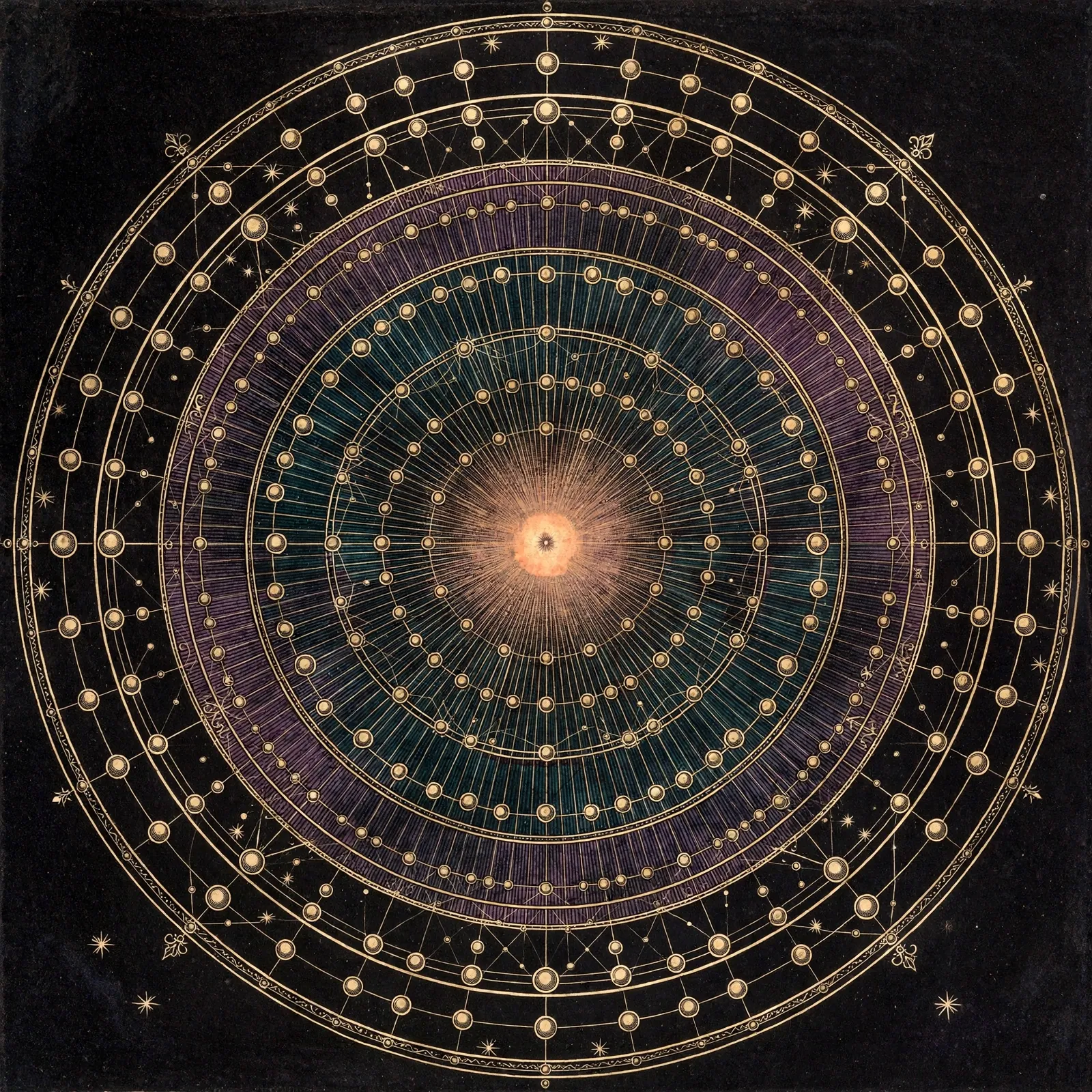
Engraved cosmological diagram in antique gold on black: concentric rings of small spheres radiating from a single glowing point of light at the center
Plate II · The Emanations A modern engraving in the antique style, drawn for this guide: the One at the center, and the Fullness overflowing outward ring by ring — aeon from aeon, sphere within sphere — until the light reaches the edge of the world it will fall into.

The divine spark — and three kinds of human

Human beings are a mixture of body and soul — but in some, a spark or seed of the higher world is trapped in matter: “the divine seed, the pearl, the spark of knowing… the self-same substance of God.” In the Apocryphon of John, the Demiurge steals power from Sophia and traps it in human bodies; the aeons trick him into breathing that power into Adam.

Valentinians systematised this into three classes, borrowing Paul’s terms (1 Cor 2:14–15): the pneumatikoi (“spiritual ones,” destined for full salvation), the psychikoi (“soulish ones” — ordinary church members, capable of a lesser salvation), and the hylikoi (“material ones,” bound entirely to matter). This spiritual elitism offended orthodox writers deeply — though modern scholars warn it has been exaggerated into a stereotype: many Nag Hammadi texts address all readers as potential knowers.

The redeemer — and the problem of Christ

To awaken the sleeping sparks, the highest God sends a revealer. In Christian forms, that revealer is Christ — but since spirit cannot truly unite with matter, Gnostic accounts denied a real incarnation in several ways:

Docetism (from dokein, “to seem”): Christ only seemed to have a body and suffer. Basilides, according to Irenaeus, taught that Simon of Cyrene was crucified in Jesus’ place while Jesus stood by and laughed.

Separationism: the heavenly Christ descended on the human Jesus at his baptism and left before the crucifixion — one reading of the cry “My God, my God, why have you forsaken me?” (Mark 15:34).

The Gospel of Thomas instead presents Jesus as a living guide to self-knowledge — see Saying 108, quoted in full in What Jesus says above: whoever drinks from his mouth becomes as he is, and the hidden things are revealed.

Salvation — ascent, not atonement

Salvation meant illumination in this life and ascent after death: the awakened soul rises through the planetary spheres, past their hostile archon-guardians, to rejoin the fullness of light. Many texts supply the passwords or formulas needed for the ascent — a practical, almost liturgical function of the myths.

Forgiveness of sins, a future bodily resurrection, and a final judgment had little or no place. Resurrection was usually reinterpreted as a present spiritual awakening — the Treatise on the Resurrection treats it explicitly this way.

Ethics — ascetics, and a disputed charge

Asceticism is well documented in the Gnostics’ own writings: many rejected marriage, sex, wine, or meat; some saw bearing children as trapping more souls in flesh. Ptolemy’s Letter to Flora insists true “spiritual” fasting is refraining from everything bad — inner motivation over ritual.

Libertinism is reported by the heresiologists and disputed by modern scholars. The Fathers accused Carpocratians, Borborites, and Cainites of holding that the body’s acts could not stain the spirit — “no more than a pearl in mud.” These reports may sometimes be exaggerated hostile caricature; Valentinian texts like the Gospel of Philip show a sacramental community, not antinomian licence.

How bad is the Demiurge? It depends on the school

Moral judgments of the creator vary sharply — one of the most important distinctions in the whole subject. Plato’s Timaeus had made the Demiurge a benevolent craftsman; the Gnostic figure is that craftsman inverted, known by deprecatory names: Yaldabaoth, Saklas (“the fool”), Samael (“blind god”). He boasts that there is no God but himself — a parody of Isaiah 45:5 — and is often identified with the God of the Old Testament.

View of the DemiurgeSchoolsConsequence
Actively malevolent — a tyrant; matter is evil, a prison Sethian / “classic” Gnostic, some Ophite groups Radical rejection of the Old Testament God; the serpent of Genesis becomes a bringer of enlightenment
Ignorant but not evil — a well-meaning, incompetent craftsman Valentinian The Old Testament is still scripture, recording an imperfect god doing his best; matter is flawed, not wholly evil
Merely the least perfect emanation — creation as an error of perception Valentinian, in its more philosophical form Materiality is not a separate evil substance but a mistake to be corrected by true perception

Dualism: three kinds, not one

Radical dualism

Two co-equal, co-eternal forces, Light and Darkness. Manichaeism is the classic case; the Persian schools generally belong here.

Mitigated dualism

One principle is inferior to the other. The classic Syrian-Egyptian movements: the material world is the work of a lesser divinity than the true God.

Qualified monism

It is arguable whether the second entity is divine at all. Pagels: “Valentinian gnosticism differs essentially from dualism” — flawed materiality results from the Demiurge being less perfect, an error of perception, not a moral fall. This is why scholars now resist calling all Gnostics “world-haters.”

Who's Who

The characters

The same figures recur across dozens of texts, sometimes under different names. This is the cast — who they are, what they do in the story, and how the schools disagreed about them.

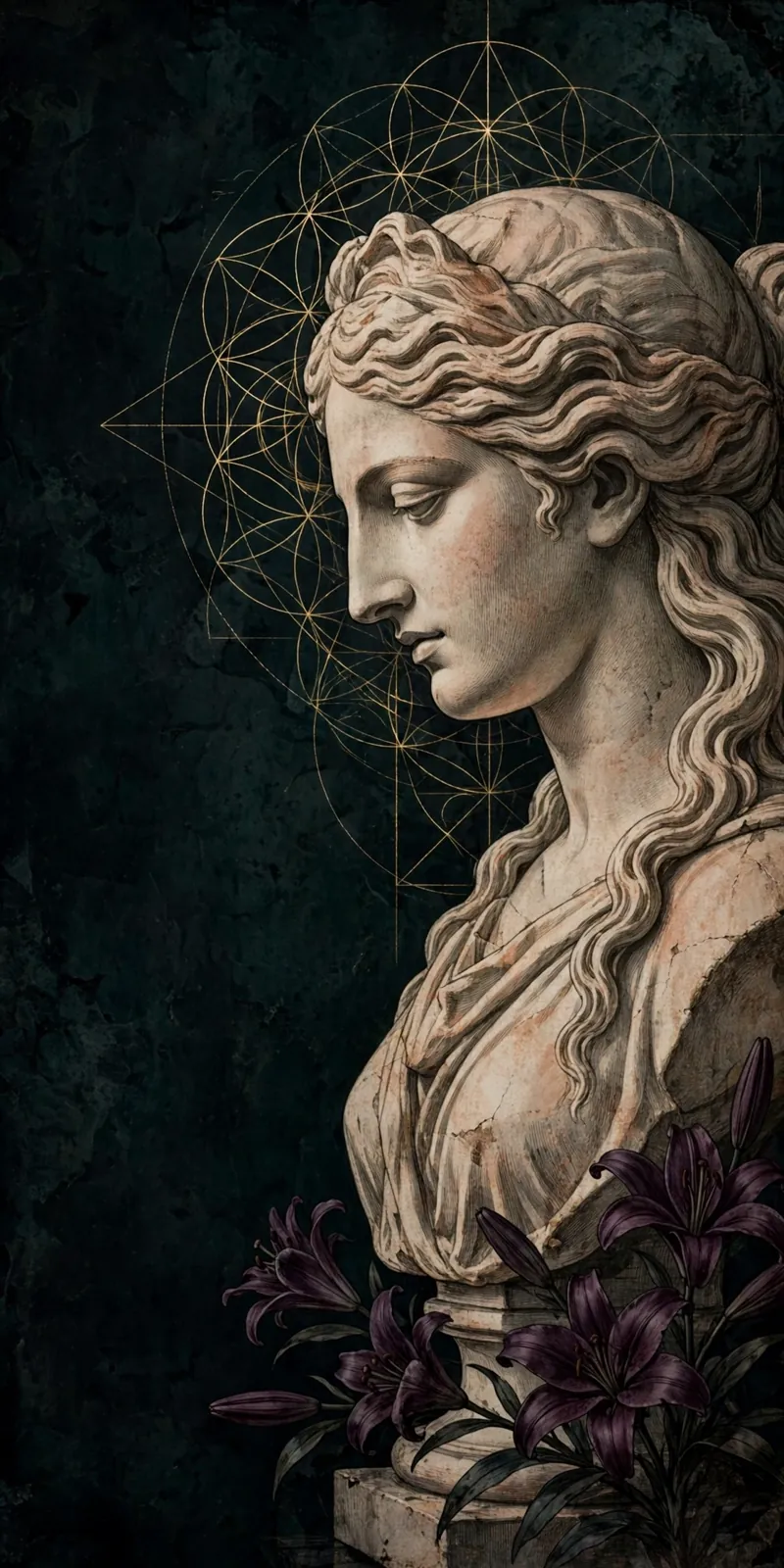
Classical marble bust of a serene woman in profile with lowered eyes, gold geometric circles behind her head and deep purple lilies at the base, against a dark teal stone ground
Plate III · Sophia A modern illustration in the antique style, drawn for this guide: Wisdom as a classical bust, eyes lowered — the aeon whose reaching sets the whole story in motion.

Above the world

The highest God

The Monad / The Invisible Spirit

Also: Bythos (Depth), the Father, the One, the Unbegotten

The source of everything and the maker of nothing in this world. Utterly transcendent — beyond being, gender, and description. He does not create matter, does not speak to prophets, and is not the God who walks in Eden. Everything good in the cosmos is an overflow from him; everything broken is what happened far below him.

First emanation

Barbelo

Also: First Thought (Protennoia), Mother, the Triple-Powered One

The first thing to come forth from the Invisible Spirit — his Thought made living. Feminine, glorious, and the mother of the aeons. In Sethian texts she is almost a second highest God, and prayers are addressed to her. She is also the voice who descends three times in the Trimorphic Protennoia to wake humanity.

The divine beings

The Aeons

Singular: aeon — “an age,” an eternity

Living powers who together make up the Pleroma. They come in male–female pairs (syzygies) — Depth & Silence, Mind & Truth, Word & Life, Humanity & Church in the Valentinian list of thirty. Think of them less as angels and more as the Father's own qualities, alive. Only one of them falls.

The fallen aeon

Sophia

Greek for “Wisdom” · Her lower part: Achamoth in Valentinian texts

The most human figure in heaven. Sophia's desire — to know the Father, or to create on her own — is the crack everything falls through. She is not evil; she is the tragedy of the system. Her grief, fear, and repentance literally become the substance of the material world, and her stolen power becomes the spark in Adam. Her restoration is the myth's promise that error is not the end.

The makers of this world

The Demiurge

Yaldabaoth

Also: Saklas (“the fool”), Samael (“blind god”), the Chief Archon · Depicted lion-faced, serpent-bodied, with eyes flashing fire

Sophia's flawed offspring and the creator of the material cosmos — identified, in Sethian texts, with the God of the Old Testament. His character is the biggest disagreement between schools: Sethians make him arrogant, jealous, and cruel; Valentinians make him ignorant but sincere, a craftsman who believes he is doing right and is himself an unwitting tool of the higher world. Either way, his defining line is his boast that no god exists beside him — spoken in ignorance of the whole Pleroma above him.

The rulers

The Archons

Greek: archontes, “rulers” · Often seven, one per planetary heaven

Yaldabaoth's offspring and administrators — the powers who govern fate, the stars, and the spheres the soul must cross after death. In the Hypostasis of the Archons they are lustful, violent, and ridiculous as often as they are terrifying: they try to seize Eve and fail, taking only a shadow. They are the prison guards of the system — and, crucially, they can be passed by anyone who knows the words and knows their own origin.

Basilidean chief of 365 heavens

Abraxas

Also spelled Abrasax · His name sums to 365 in Greek numerals

In Irenaeus's report of Basilides, the ruler of the highest of 365 heavens created by angelic powers. Later ages turned Abraxas into a magical name carved on amulets — a rooster-headed, serpent-legged figure on “Abrasax stones” — far beyond anything Basilides himself can be shown to have taught.

Mandaean maker

Ptahil

The Demiurge-figure of Mandaeism. A being of light sent to create the material world (Tibil), who does the work with the help of dark powers and produces a world neither wholly light nor wholly dark — which is why, for Mandaeans, repeated baptism is needed to keep the soul oriented toward the World of Light.

Inside the world

First humans, retold

Adam & Eve

Adam is built by committee — dozens of archons each making a part — and comes alive only when heaven's stolen power is breathed into him, which makes the first human inwardly superior to his makers. Eve is split in the telling: her material form is made by the archons, but her spiritual self — the Epinoia of Light hidden in Adam — is the one who wakes him, teaches him, and raises him up. In several texts Eve is Adam's saviour before Christ is anyone's.

Keeper of the seed

Seth & Norea

Seth, Adam and Eve's third son, is the ancestor of the “immovable generation” — those who carry the spark. Sethian texts are revelations given to him or through his line. Norea, his sister-wife (and in other tellings Noah's wife), is a hero in her own right: in the Hypostasis of the Archons she confronts the archons, is rescued by the angel Eleleth, and receives the revelation that explains the whole system. She also, in one account, burns the ark when Noah will not let her aboard.

The revealer

Christ / The Saviour

Not the Demiurge's son and not his prophet — an envoy from the Pleroma who passes through the archons' heavens in disguise. Schools split on his body: docetic accounts say he only seemed to suffer; separationist accounts say the heavenly Christ joined the man Jesus at baptism and left before the cross; the Gospel of Thomas barely concerns itself with his death at all — his words are the rescue. See What Jesus says — and how the Gnostics heard it.

Witness & teacher

Mary Magdalene

In the Gospel of Mary, the Gospel of Philip, and Pistis Sophia, Mary is the disciple who understands — the one who receives visions, asks the deepest questions, and steadies the frightened apostles after the resurrection. Peter's resentment of her in these texts is presented as a failure to understand, and Levi's defence of her — “if the Saviour made her worthy, who are you to reject her?” — is one of the most quoted moments in the whole library.

The teachers — real people

Valentinus c. 100 – c. 180

Egyptian-born poet-theologian, taught in Alexandria and Rome. Nearly became — by hostile report — bishop of Rome. Built the most intellectually complete Gnostic system and the school that lasted longest inside the church itself.

Basilides fl. 117–138

Alexandrian teacher under Hadrian. Claimed a chain back to Peter through Glaucias. Wrote commentaries and hymns — all lost. We know him only through enemies who contradict each other.

Marcion d. c. 160

Wealthy shipowner from Sinope who forced the canon question by publishing his own: one edited Gospel, ten letters of Paul, no Old Testament at all. Whether he counts as Gnostic is the test case in Section 5.

Mani 216–276

Persian prophet who turned dualism into a world religion with scriptures, a church, and missionaries from North Africa to China. Died in prison under the Sasanian king Bahram I.

The Symbols

Three signs of the Gnostic world

Before these ideas were argued in books, they were carried in images — carved on gems, worn as amulets, drawn in the margins of alchemical manuscripts. A symbol here is the whole story compressed into one figure. These are the three that hold the most of it. The first one is this page’s emblem — you will find it at the top.

Engraving of the Ouroboros — a serpent eating its own tail and forming a perfect circle, on aged parchment

The closed loop

The Ouroboros

The serpent eating its own tail, forming a circle with no beginning and no end. The image is older than Gnosticism — it appears in Egyptian and Greek sources — and it was taken up into Gnostic and alchemical art. Its most famous early appearance, in the Chrysopoeia of Cleopatra, rings the serpent with the words “One is the All” (hen to pan): everything is one, and the One is in everything.

Read through the myth told on this page, the circle is also the trap. It is the endless cycle of birth, death, and rebirth inside the material world — fate’s machinery, heimarmenē, turning and turning. Souls who do not know where they came from are turned back at death into another body, another round of forgetting (see the story, step 8). The loop is perfect, beautiful, and closed. Gnosis is what breaks it — the awakened soul does not go around again; it passes out, upward, back to the Pleroma. That is why the Ouroboros sits at the top of this page: it is both the All the Gnostics revered and the prison they were trying to leave.

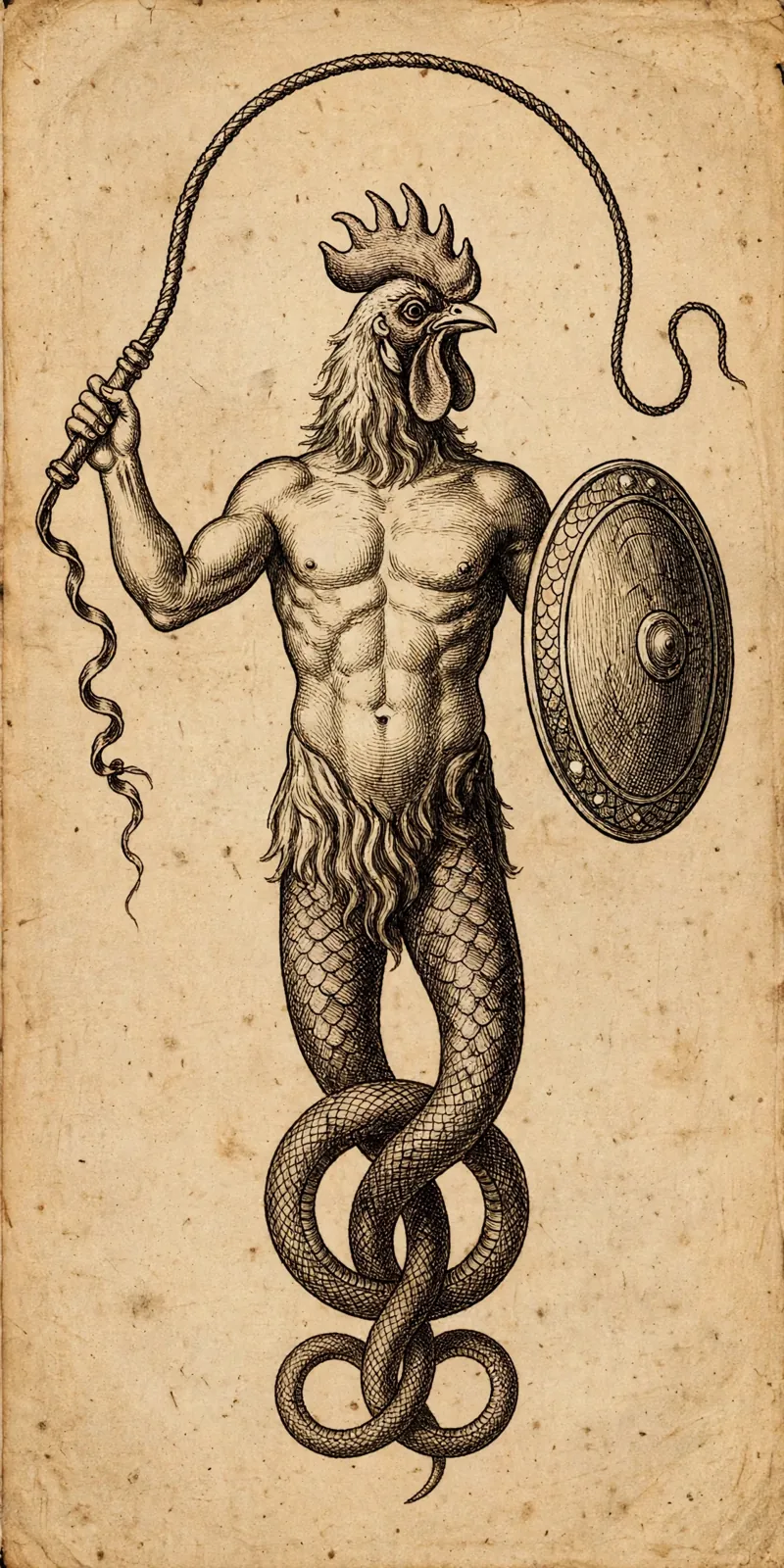
Engraving of Abraxas — a rooster-headed figure with a human torso and arms, serpent legs, holding a shield and a whip

Lord of the 365 heavens

Abraxas

Rooster’s head, a man’s torso and arms, and serpents for legs — carrying a shield in one hand and a whip in the other. In Irenaeus’s report of Basilides, Abraxas is the ruler of the highest of 365 heavens, each created and governed by angelic powers. The number is the point: the Greek letters of his name add up to 365 (α=1, β=2, ρ=100, α=1, ξ=60, α=1, σ=200) — one heaven for every day of the year, the whole calendar of the cosmos stacked under a single lord.

The image long outlived the teaching. Abraxas was carved onto gemstone amulets — the so-called Abrasax stones — and worn across the Roman world as a protective power, by people who may have known nothing of Basilides at all. He is the Gnostic cosmos turned into a body: the bird that heralds the dawn on top, the human in the middle, the serpents of the lower world below — every layer of reality in one figure.

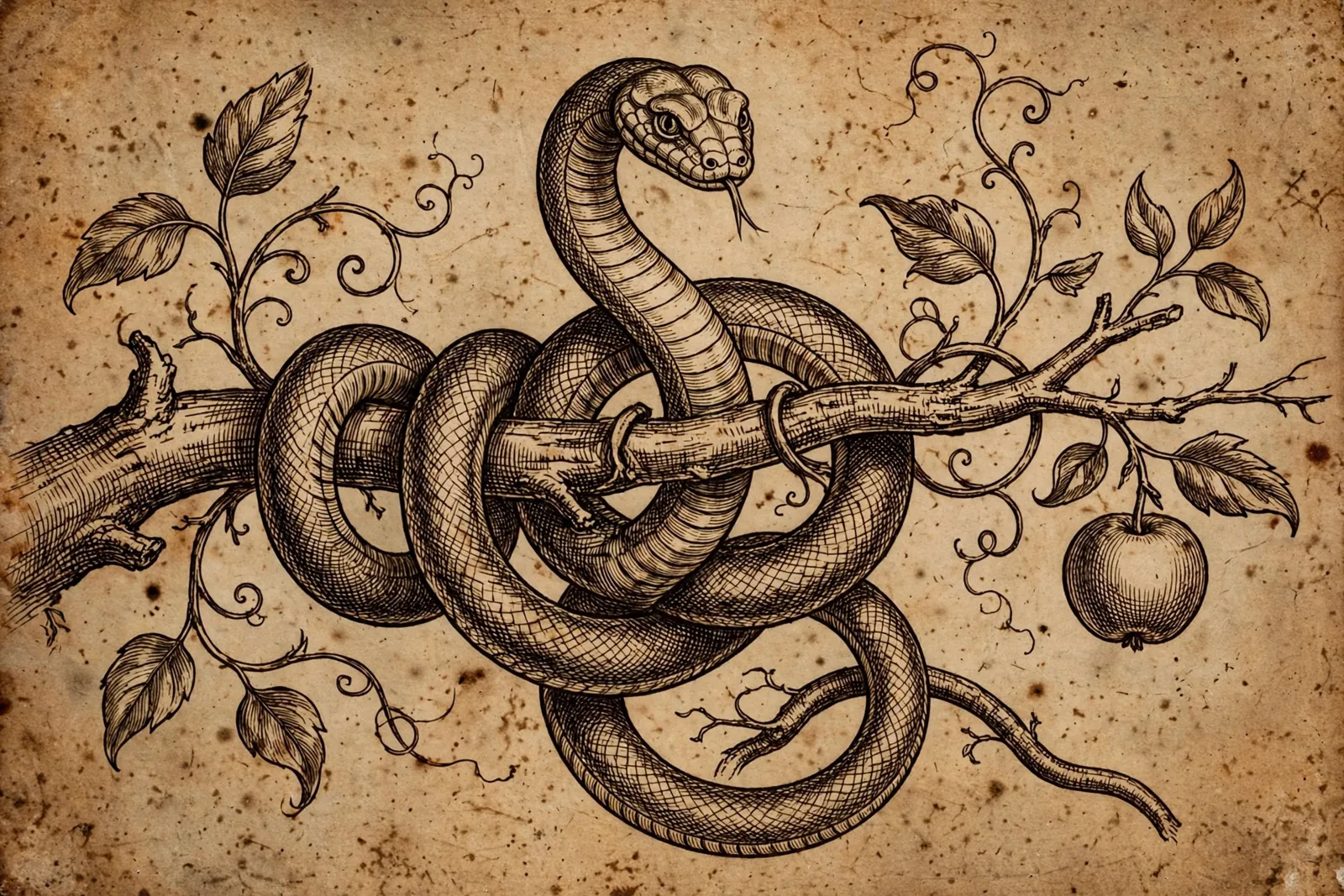
Engraving of a serpent coiled around a branch of the Tree of Knowledge, with a single fruit hanging beside it

The bringer of knowledge

The Serpent

In the Genesis most people know, the serpent is the tempter — the villain of Eden. In the Gnostic retelling, it is the one telling the truth. The command not to eat from the Tree of Knowledge comes from the jealous Demiurge; the serpent urges Adam and Eve to eat anyway — and when they do, their eyes open, they see their makers for what they are, and ignorance cracks for the first time (see the story, step 5). Eating is not the Fall. Eating is the first awakening.

Whole groups were named for it: the Ophites, from ophis, Greek for serpent, and the Naassenes, from naḥash, Hebrew for serpent. In some texts the serpent’s role is taken by Eve in her spiritual form, or by Christ himself — the serpent is a mask the higher world wears to reach inside the prison. And the image cuts both ways: Yaldabaoth, the jailer, is serpent-bodied too. Liberator and tyrant wear the same shape in this mythology — and telling them apart is itself an act of gnosis.

A note on the images: the three engravings here — like the plates elsewhere in this guide — are modern illustrations in the antique style, drawn for this guide — the ancient originals survive as small gem carvings (for Abraxas) and manuscript drawings (for the Ouroboros), not as full-page plates.

Section 4

Origins and development, 1st–4th centuries CE

Gnosticism took shape where a common stock of Greco-Roman ideas — a Platonic contrast between spirit and matter, a supreme God too exalted to touch the world directly, a soul fallen into the body, the longing for secret initiation — met Jewish scripture and the Christian proclamation. Alexandria, whose Christian community was of Jewish-Christian origin but attracted Greek members, was of central importance.

  1. c. 20 BCE – 50 CE

    Philo of Alexandria fuses Platonic dualism with Jewish theology; his Logos as divine intermediary and allegorical readings of Genesis prefigure Gnostic ideas.

  2. Late 1st century

    Gnostic ideas develop alongside the writing of the New Testament. Genesis is reinterpreted in Jewish milieux; a myth forms of a heavenly revealer descending to show humanity its true home. Figures: Simon Magus (Acts 8), Menander of Antioch, Cerinthus (Asia Minor, c. 100).

  3. c. 117–138

    Basilides teaches in Alexandria under Hadrian. Saturninus teaches at Antioch (early 2nd c.).

  4. c. 135–165

    Valentinus is active in Alexandria, then Rome. Marcion arrives in Rome c. 140 and breaks with the Roman church in 144.

  5. c. 150

    Justin Martyr writes a Syntagma against all heresies (now lost).

  6. c. 178

    The pagan critic Celsus attacks Christianity, and knows Ophite teaching well enough to describe their cosmic diagram.

  7. c. 180–185

    Irenaeus, bishop of Lyon, publishes Against Heresies in five books. This is the high point of the classical Gnostic teachers: mid-2nd to early 3rd century.

  8. Early 3rd century

    Hippolytus writes his Refutation of All Heresies; Tertullian writes Against the Valentinians (c. 206) and five books Against Marcion (c. 207–208). Plotinus attacks the Gnostics in Enneads II.9 for their contempt of the cosmos.

  9. 216–276

    Mani founds Manichaeism in Mesopotamia; it will briefly rival Christianity.

  10. 3rd century

    Decline sets in for the western Gnostic schools as proto-orthodoxy rises and the Roman Empire deteriorates. Sethianism shifts toward contemplative Platonism — and is attacked by the Neoplatonists in turn.

  11. c. 325

    Council of Nicaea. (The canon was not settled there — see Section 7.)

  12. c. 350–400

    The Nag Hammadi manuscripts are copied in Coptic — and the codices are buried, for reasons still debated.

  13. 367

    Athanasius of Alexandria’s 39th Festal Letter gives the first surviving list matching the 27-book New Testament, and condemns other books.

  14. c. 375

    Epiphanius of Salamis publishes the Panarion (“Medicine Chest”), cataloguing some eighty heresies.

  15. 4th–5th centuries

    Imperial laws from Christian emperors suppress Gnostic groups; some survive into the 5th century. Manichaeism persists in the East — in China, into the 9th century and beyond.

Not yet “orthodoxy vs. heresy”

In the first century and a half of Christianity, no single acceptable format of Christian thought had yet been defined. Gnosticism was one of many currents “moving within the deep waters of the new religion,” and the ultimate course Christianity would take “was undecided at this early moment” (Gnosis Archive). Gnostics and proto-orthodox Christians shared terminology and many of the same scriptures, and were initially hard to distinguish. Valentinus may have been considered for election as Bishop of Rome in the mid-2nd century; Valentinians could recite the church’s confession and join its worship while understanding the words in their own sense — which made them especially troubling to church leaders.

Walter Bauer famously argued that “heresies” may have been the original form of Christianity in many regions. Pagels developed this: the proto-orthodox church’s debates with Gnostic Christians helped stabilise its own beliefs. Gilles Quispel went further — Catholicism arose in response to Gnosticism, building safeguards in the monarchic episcopate, the creed, and the canon. Against this, Larry Hurtado argues proto-orthodox devotion to Jesus was rooted in the first century and developed tradition rather than inventing it.

The New Testament itself shows early stages of the argument — though it nowhere describes a full Gnostic system, and reading the developed 2nd-century myths back into it is anachronistic. It confronts tendencies that later fed into Gnosticism: Corinthians who prized knowledge and denied the resurrection (1 Cor 15); the Colossian teaching answered by insisting that “in Christ all the fullness [plērōma] of the Deity lives in bodily form” (Col 2:9); opponents devoted to “myths and endless genealogies” (1 Tim 1:4) and “what is falsely called knowledge” (1 Tim 6:20 — the phrase Irenaeus took as his title); 1 John’s opponents who denied that “Jesus Christ has come in the flesh” (1 John 4:2). Paul was a particular crux — Tertullian called him “the apostle of the heretics,” and Clement reports that Valentinus’s disciples traced his teaching through Theudas, a student of Paul. Pagels notes Paul could be considered both a proto-Gnostic and a proto-Catholic.

The philosophical debt — and the philosophers’ reply

Middle Platonism supplied the conceptual grammar: the transcendent One, the Demiurge as craftsman, emanation in grades, the soul’s fall and its return by contemplation. The vocabulary — hypostasis, ousia, demiurge — is borrowed wholesale from Greek philosophy. Zoroastrianism supplied, at least for the Persian schools, the model of two opposed cosmic principles, Light and Darkness.

Then Neoplatonism turned on its borrowers. Plotinus (3rd century), in Enneads II.9, Against the Gnostics, argued the material world was not inherently evil but a reflection of the One; Porphyry and Proclus continued the critique, defending the Demiurge as benevolent. It is a valuable external witness: the most sophisticated pagan philosophers of the age regarded the Gnostics as getting Platonism wrong — too dualist, too contemptuous of the cosmos.

Section 4 · continued

Where did it come from? Four rival answers

The origins of Gnosticism are, in the words of every major source, “obscure and still disputed.” Karen King showed that each of the four major proposals is organised less by evidence than by its implications for Christian identity.

1 · A Christian heresy

The heresiologists’ own view, and Adolf von Harnack’s: Gnosticism as “the acute Hellenization of Christianity” — an internal corruption of an originally pure gospel under Greek influence. Simone Pétrement argued it grew from Christianity itself, especially a radical reading of Paul and John.

2 · A variant form of Christianity

One of several responses to the life, death, and presumed resurrection of Jesus. David Brakke and others argue Gnosticism originated as an intra-Christian movement — not a foreign import but a sibling.

3 · A pre-Christian religion

The German history-of-religions school: Bousset saw Iranian/Mesopotamian syncretism; Reitzenstein posited a pre-Christian myth of a descending redeemer; Bultmann built on it. But Carsten Colpe’s critique (1961) showed no source clearly earlier than Christianity contains such a redeemer myth — most scholars now think the Gnostic redeemer was modelled after Christ, not the reverse.

4 · An independent Jewish tradition

Now the most influential view: Gnosticism arose within Second Temple / heterodox Judaism and later incorporated Jesus. Gershom Scholem detected Jewish gnosis in merkabah (divine-chariot) mysticism; Gilles Quispel traced it to Alexandrian Jews. Many Nag Hammadi texts rework Genesis and Jewish wisdom traditions — sometimes with violent rejection of the Jewish God. R. M. Grant suggested disillusioned hopes after the fall of Jerusalem in AD 70 played a part.

The current consensus is best stated negatively: no single origin can be traced. James M. Robinson’s verdict: “no Gnostic texts clearly predate Christianity,” and “pre-Christian Gnosticism as such is hardly attested in a way to settle the debate once and for all.” A possible Buddhist influence, floated at the 1966 Messina congress, is not supported by modern scholarship for Valentinus or the Nag Hammadi texts.

The Umbrellas

All the umbrellas: what sits under “Gnosticism”

“Gnosticism” is an umbrella over an umbrella. Under the big modern label sit several ancient families, and under each family sit teachers, sects, and texts that do not always agree with each other. This map shows the whole canopy — including the neighbours who are often shelved with the Gnostics but are not quite the same thing.

The core families

Sethian

The prototype. Named for Seth, son of Adam. Barbelo, Sophia's error, evil Yaldabaoth, the Five Seals baptism, ascent literature. Texts: Apocryphon of John, Hypostasis of the Archons, Gospel of the Egyptians, Zostrianos. If a textbook needs one example of “classic Gnosticism,” it uses this one.

Valentinian

The church-inside-the-church. Thirty aeons, a Demiurge who is ignorant rather than evil, sacraments including the bridal chamber, three classes of humanity. The largest, longest-lived, and most intellectually ambitious school — East (Theodotus, Marcus) and West (Ptolemy, Heracleon).

Basilidean

The lost system. Alexandria, 365 heavens, Abraxas. Survived in Egypt into the 4th century, but no writing of Basilides survives — the family is known entirely at second hand.

Thomasine

The wisdom stream. Gathered around sayings attributed to Jesus through Thomas — Gospel of Thomas, Book of Thomas, Acts of Thomas. Often no Demiurge myth at all: salvation by interpreting sayings and knowing oneself. Scholars increasingly treat this as its own tradition that only partly overlaps Gnosticism.

Ophite & related mythic sects

The serpent groups. Ophites, Naassenes, Cainites, Barbelo-Gnostics in the heresiologists' lists — groups organised around reversing Genesis: the serpent as enlightener, the biblical villains as heroes, the biblical God as the villain. Evidence for some of these comes almost entirely from hostile catalogues, so the tidy labels may hide messy realities.

Carpocratian & other small circles

Carpocrates and his son Epiphanes in Alexandria; Saturninus in Antioch; Cerinthus in Asia Minor; Simon Magus and Menander at the legendary root. Small teacher-circles, often known from a paragraph or two in an opponent — included here because the umbrella is incomplete without them, and flagged because so little survives.

The borderlands — related, debated, distinct

Marcionite — borderline

Two gods, no Old Testament, the first Christian canon — but salvation by faith, taught openly, with no aeons, no fall myth, and no secret knowledge. Most scholars now keep Marcion next to the umbrella rather than under it. See the full verdict in Schools & figures.

Manichaean — a world religion of its own

Mani's system (from 240s CE) took the trapped-light myth and built a complete, missionary, dualist religion — Light vs. Darkness as two co-eternal kingdoms. It absorbed Gnostic ideas and then outgrew the category entirely.

Mandaean — the living survivor

A baptising religion of southern Iraq and Iran, still practised today, revering John the Baptist, with its own scriptures (Ginza Rabba), priests, and Demiurge-figure (Ptahil). Whether it is a Gnostic sect that survived or a cousin that helped invent the family is still argued.

Hermetic — the philosophical neighbour

The Corpus Hermeticum — revelations of Hermes Trismegistus — shares the language of ascent, rebirth, and secret knowledge, and three Hermetic texts were literally bound into the Nag Hammadi library. But Hermetism is generally optimistic about the cosmos in a way Sethian myth is not. A neighbour, not a branch.

Later echoes often placed under the umbrella

  • Paulicians (Armenia, 7th–9th c.), Bogomils (Balkans, from 10th c.), and Cathars (southern France, 12th–13th c.) — medieval dualists who taught that the material world was made by an evil or lesser power. Often called “medieval Gnostics” or “Neo-Manichaeans.” The resemblance is real; direct descent from the ancient schools is disputed, and Cathars placed little weight on gnosis itself.
  • Modern Gnostic churches — Ecclesia Gnostica, Apostolic Johannite Church, Jules Doinel's 1890 French Gnostic Church and its successors — are revivals built from the recovered texts, not survivals. Only Mandaeism is an unbroken ancient tradition.
  • “Gnostic” as a mood — Jung's psychology, existentialism in Hans Jonas's reading, The Matrix, Philip K. Dick — uses the umbrella metaphorically: a false world, a hidden truth, awakening as salvation. Useful shorthand, not history.
The honest summary: Sethian and Valentinian are securely under the umbrella. Basilidean and Thomasine sit under it with caveats. Marcionite, Manichaean, Mandaean, and Hermetic are borderlands — shelved together because they share the myth's DNA, separated because each became something else. Medieval dualists and modern revivals are echoes, not branches.

Section 5

Schools and figures

There was no Gnostic church, no Gnostic council, no Gnostic pope. There were teachers and their circles, loosely organised around an individual in a particular city — Alexandria, Rome, Antioch, Edessa. The schools are best understood as distinct maps of the same territory, drawn for different purposes. Select a school to explore it; Marcion, the contested fourth case, gets his own verdict.

Sethianism — the “classic” Gnostics

No single founder · attributed to Seth, third son of Adam · Alexandria & Egypt, 2nd–3rd centuries

Sethianism is the prototype of Gnosticism as Irenaeus condemned it — his summary of the Barbelo-gnostic myth is a Sethian myth, and Bentley Layton reserves “classical Gnostic” for texts that refer to it. Sethians attributed their gnosis to Seth and to Norea, wife of Noah, ancestors of the spiritual race — the “seed of Seth.” John D. Turner sees Sethianism originating as a fusion of two groups: a Jewish baptising group, the Barbeloites (named for Barbelo, first emanation of the Highest God), and biblical exegetes, the Sethites.

Highest God
The Invisible Spirit; first emanation Barbelo, a divine mother figure
The fall
Sophia emanates alone, without her consort, producing Yaldabaoth by accident or error
The Demiurge
Evil, arrogant, ignorant — a tyrant and jailer: Yaldabaoth
The Old Testament
Hostile rejection; Genesis retold with values reversed — the serpent becomes the enlightener
Salvation
Gnosis of the seed of Seth; the Five Seals ritual — quintuple immersion, chanting divine names, ascent through the heavens
Key texts
Apocryphon of John, Hypostasis of the Archons, Gospel of the Egyptians, Apocalypse of Adam, Three Steles of Seth, Zostrianos, Allogenes, Trimorphic Protennoia

Its trajectory is telling: by the early 3rd century Sethianism was fully rejected by Christian heresiologists and shifted toward contemplative Platonism; in the late 3rd century Plotinus and the Neoplatonists attacked it too; by the early-to-mid 4th century it fragmented into groups like the Archontics, Audians, Borborites, and Phibionites. Later Sethian texts draw on late Middle Platonism “with no traces of Christian content” — Sethianism ended as much a philosophical as a Christian phenomenon.

A scholarly caution: Roelof van den Broek warns that “Sethianism” may never have been a separate religious movement at all — the term may refer only to a set of mythological themes occurring in various texts. German and American scholarship tends to see it as an inner-Jewish phenomenon; British and French scholarship, as heterodox Christian speculation.

The smaller groups — and why they matter

  • Simon Magus and the Simonians. The Samaritan magician of Acts 8, regarded by the Fathers as the father of all heresy. His successor Menander taught at Antioch late in the 1st century. Modern scholars treat the ascription of later systems to the Simon of Acts as partly legendary.
  • Saturninus of Antioch (early 2nd c.): the world made by angels, Christ a redeemer without a real body, marriage and procreation from Satan.
  • Cerinthus (Asia Minor, c. 100): separationist Christology and observance of Jewish law. Irenaeus says John wrote his Gospel partly to refute him — and relates, on Polycarp’s authority, that John fled a bathhouse on learning Cerinthus was inside.
  • Carpocrates and Epiphanes (Alexandria): Clement quotes Epiphanes advocating property — and even wives — held in common: the seed of the libertinism charge.
  • Ophites / Naassenes (“Serpent Gnostics”): gave the serpent of Genesis 3 a positive role as bringer of knowledge (ophis = serpent). The Cainites are said to have honoured figures the Bible condemns — Cain, Esau, Korah — though little independent evidence exists.
  • Thomasines: texts attributed to Thomas. Karen King notes “Thomasine Gnosticism” as a separate category is itself being criticised — Thomas may be a wisdom tradition that only later turned Gnostic.
  • Baptising groups of the Jordan valley: the Elkesaites (100–400 CE), Samaritan Baptist sects, and the Mandaeans (Section 9) — milieux where the idea emerged that the world was created by ignorant angels and baptism led to regeneration.

Section 6

The Nag Hammadi library: the Gnostics in their own words

For nearly 1,800 years, almost everything known about the Gnostics came from their enemies. The chief witnesses were the heresiologists — Irenaeus (c. 180), Justin, Tertullian, Hippolytus, Clement, Origen, Epiphanius. A few Coptic books surfaced in the 18th–19th centuries (the Pistis Sophia in the Askew Codex; the Books of Jeu in the Bruce Codex; the Berlin Codex of 1896, unpublished in full until 1955). Then came December 1945.

The discovery

On a December day in 1945, near Nag Hammadi in Upper Egypt, a farmer named Muhammad Ali al-Samman, digging for sabakh fertiliser at the base of the Jabal al-Tarif cliffs, struck something hard: a sealed red earthenware jar about two feet tall. Fearing jinn, he hesitated — then smashed it open. Inside were no treasure and no genie, but books: thirteen leather-bound papyrus codices.

The losses began at once: al-Samman’s mother, not knowing what she was looking at, burned some of the pages for kindling, and leaves are missing from every codex. The manuscripts passed through dealers; one (Codex I) was bought in 1952 for the C. G. Jung Institute in Zurich and is still called the Jung Codex. The collection was finally assembled at the Coptic Museum in Cairo, where it remains. A facsimile edition appeared in the 1970s under James M. Robinson; the complete English translation, The Nag Hammadi Library in English, arrived in 1977 — thirty-two years after the discovery. With the Dead Sea Scrolls (found 1947), it was one of the two most consequential manuscript finds of the 20th century.

The library holds 52 texts (“tractates,” some duplicated), written in Coptic and nearly all translated from Greek originals. The manuscripts were copied in the 3rd–4th centuries (usually dated c. 350–400 CE); the lost Greek originals are proposed at 1st–2nd century, though this is disputed — most scholars place composition in the 2nd–3rd centuries. Not everything is Gnostic: the collection also includes three works from the Corpus Hermeticum and a partial reworking of Plato’s Republic.

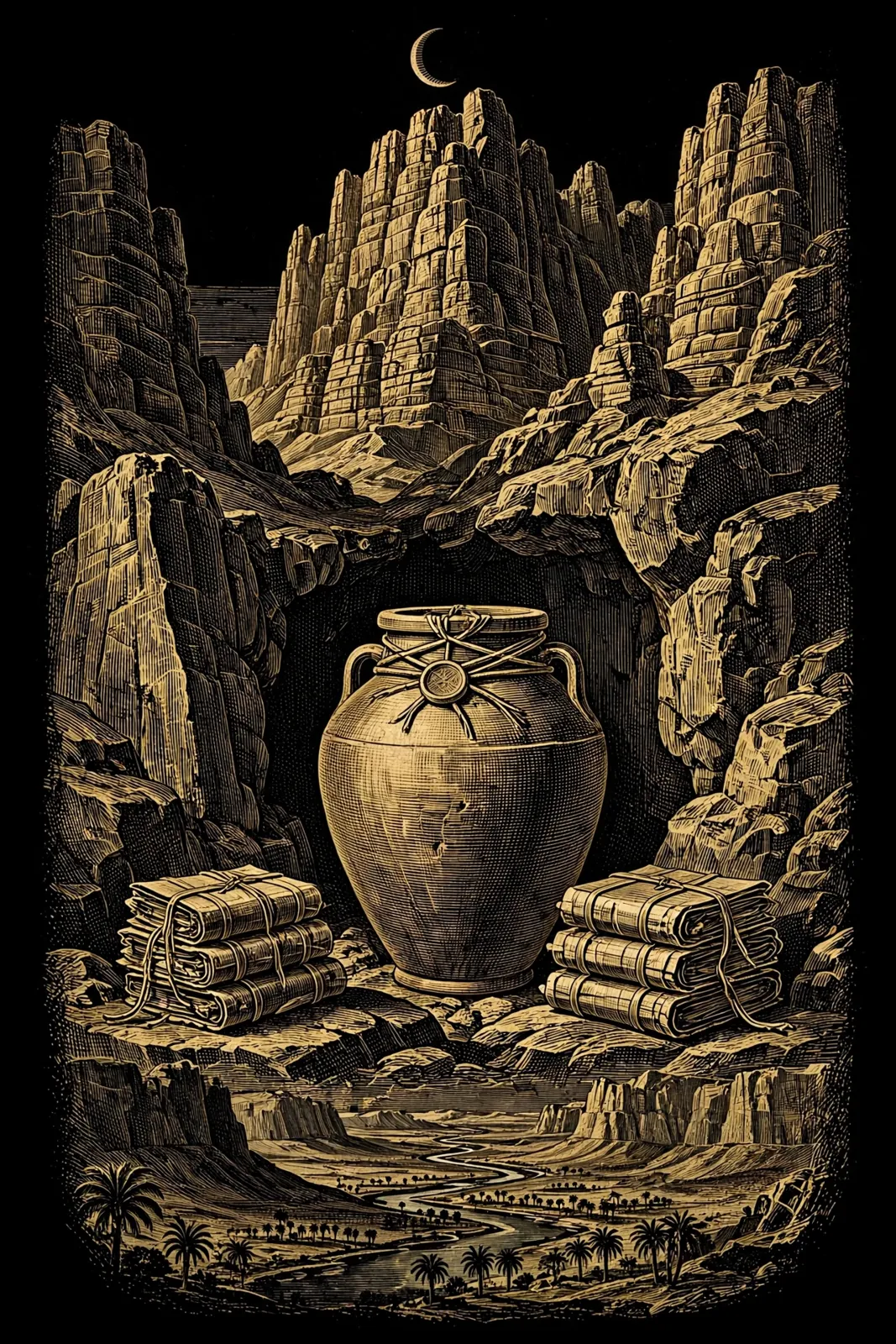
Engraving in gold on black: a large sealed clay jar flanked by stacks of leather-bound codices at the foot of towering desert cliffs under a crescent moon, with a river valley and palm trees far below
Plate IV · The Jar A modern engraving in the antique style, drawn for this guide: the sealed jar and its codices at the foot of the Jabal al-Tarif cliffs, the Nile valley below — where the library waited, hidden, for some sixteen centuries.

The major texts

Apocryphon of John — the most important

“The Secret Book of John” survives in three copies at Nag Hammadi (Codices II, III, IV) plus a fourth in the Berlin Codex — the most-copied text in the library, a sign of its centrality. A revelation dialogue between the risen Jesus and the apostle John, it gives the fullest Gnostic myth: the unknowable Father and the aeons; Sophia’s passion and the birth of Yaldabaoth, the lion-faced Demiurge; the creation of Adam and Eve; the spark’s entrapment and the promise of awakening. Its retelling of Genesis 1–3 is the most sustained Gnostic rewriting of the Bible, and it is the text behind Irenaeus’s Barbelo-gnostic summary.

Gospel of Thomas — the most famous, the most contested

A collection of 114 sayings of Jesus — no birth, no miracles, no passion, no resurrection narrative. “These are the secret sayings which the living Jesus spoke and which Didymus Judas Thomas wrote down.” Its kingdom is present and interior: “The kingdom is inside you” (Saying 3). The Nag Hammadi copy (c. 340 CE) is the only complete text; Greek fragments dating to about AD 200 were found at Oxyrhynchus decades earlier.

Whether it is Gnostic at all is debated — it has no Demiurge, no aeons, no fall of Sophia. Dating is equally contested: origins anywhere from the mid-1st to the mid-2nd century. Helmut Koester argued its sayings are older than the canonical parallels; John P. Meier and the majority conclude it depends on or parallels the Synoptics and cannot serve as a reliable source for the historical Jesus.

Read all 114 sayings in full → — the complete text is in the Jesus’s Words room of the archive.

Gospel of Philip — a Valentinian anthology

Discourses and sayings on the sacraments — baptism, chrism, Eucharist, redemption, and above all the bridal chamber — and on the relation between earthly and heavenly realities. It is the richest source for Valentinian ritual life, and it critiques literal readings of the virgin birth and bodily resurrection as misunderstandings.

Its famous passage says Jesus loved Mary Magdalene more than the other disciples and “used to kiss her often on her […]” — the key word is missing from the manuscript; “mouth” is a reconstruction, and the passage’s meaning is disputed rather than settled.

Gospel of Truth — a Valentinian homily

A sermon-like meditation on the Father, on ignorance and forgetfulness as the human condition — error personified as a fog — and on Jesus as the one who makes the Father known and brings rest. It shows little of the elaborate aeon speculation of the Valentinian system and is among the most beautiful prose in the library. Irenaeus mentions a Valentinian Gospel of Truth; the Nag Hammadi text is generally regarded as that work — attributed once to Valentinus, now more often to a close disciple.

Gospel of Mary — Berlin Codex, not Nag Hammadi

A revelation dialogue in which Mary Magdalene comforts the frightened apostles after the resurrection and recounts a vision of the soul’s ascent past hostile powers. Peter challenges her authority — “Did he really speak privately with a woman and not openly to us?” — and Levi defends her. Pagels made it a centrepiece of her argument that some Gnostic communities gave women more prominent roles than the developing proto-orthodox church. Women in Nag Hammadi texts also appear as leaders and heroes — and the Thunder: Perfect Mind is a monologue by a feminine divine power.

Gospel of Judas — the other great modern find

Not from Nag Hammadi: the Codex Tchacos, published in 2006, contains a gospel Irenaeus had mentioned around AD 180 — one in which Judas Iscariot, far from a traitor, is the only disciple who understands Jesus and carries out his master’s secret instruction. It confirmed, again, that the heresiologists’ reports were often accurate in outline.

More of the library

TextCodexWhat it is
Hypostasis of the ArchonsII“The Reality of the Rulers” — Genesis retold: the archons create Adam, the spiritual Eve awakens him, and the rulers’ power is exposed as a sham
On the Origin of the WorldIIA long creation myth — Sophia, the Demiurge, and a final vision of the end of the archons’ rule
The Thunder: Perfect MindVIA monologue by a feminine divine power speaking in paradoxes — “I am the first and the last… I am the whore and the holy one” — with no narrative frame at all
The Exegesis on the SoulIIAn allegory of the soul’s fall (as a prostitute) and redemption (as a bride)
The Tripartite TractateIThe longest Valentinian theological treatise: the Father, the Son, the Church, and the three classes of humanity
Treatise on the ResurrectionIThe Letter to Rheginos — resurrection as a present spiritual event, not a future bodily one
Apocalypse of AdamVAdam’s revelation to Seth; regarded by some scholars as Gnostic but not Christian, with signs of a pre-Christian stratum
Zostrianos · Allogenes · Three Steles of SethVIII · XI · VIILate Sethian/Platonic ascent literature — visions of the heavenly realms with almost no Christian content
The Trimorphic ProtennoiaXIIIBarbelo as the voice that descends three times to awaken humanity
Hermetica & PlatoVIDiscourse on the Eighth and Ninth, Asclepius, and a Republic excerpt — the library’s non-Gnostic minority, evidence it was a working library, not a sectarian canon

Why was the library buried? Two hypotheses, no verdict

Hidden from the bishop — Robinson / Pagels

The codices were produced at the nearby Pachomian monastery at Chenoboskion; scrap papyrus stiffening the bindings includes receipts datable to the mid-4th century. The best estimate for the burial is around 367 CE — the year Athanasius’s Festal Letter listed the 27 New Testament books and ordered other books destroyed. On this account, monks chose preservation over obedience and hid the jar in the cliff at Jabal al-Tarif.

Buried with the dead — Denzey Lewis

Nicola Denzey Lewis (Introduction to “Gnosticism,” 2013) reads the library as a funerary deposit — books buried as grave goods, in the genre of the Egyptian Book of the Dead. The texts’ obsession with the topography of the metaphysical realms suits a funerary context, and burying a luxury book in a tomb was not unusual in late ancient Egypt. On this account, the burial need not have been an act of resistance at all.

Hypothesis, not fact: both readings fit some of the evidence; neither is proven. What is certain is that the codices were hidden in the mid-4th century — and survived because they were hidden.

What the discovery changed

After 1945, scholars could read the Gnostics’ scriptures, prayers, sacramental theology, and doubts — and found them more diverse, more biblical, and less uniformly world-hating than the heresiologists had suggested. The Gospel of Thomas has no Demiurge; the Gospel of Truth has almost no mythology; the Tripartite Tractate is systematic theology; the Thunder is a poem. The library demonstrated the fluidity of early Christian scripture itself — and precisely this diversity fuelled the category debate in Section 8. One reassurance ran the other way: on many points, the recovered texts confirm the Fathers’ descriptions — though they show more variety than the Fathers’ summaries suggest.

More Stories

More stories from the texts

Beyond the big creation myth, the library is full of smaller stories — retellings, poems, arguments, and ascents. These are the ones readers remember.

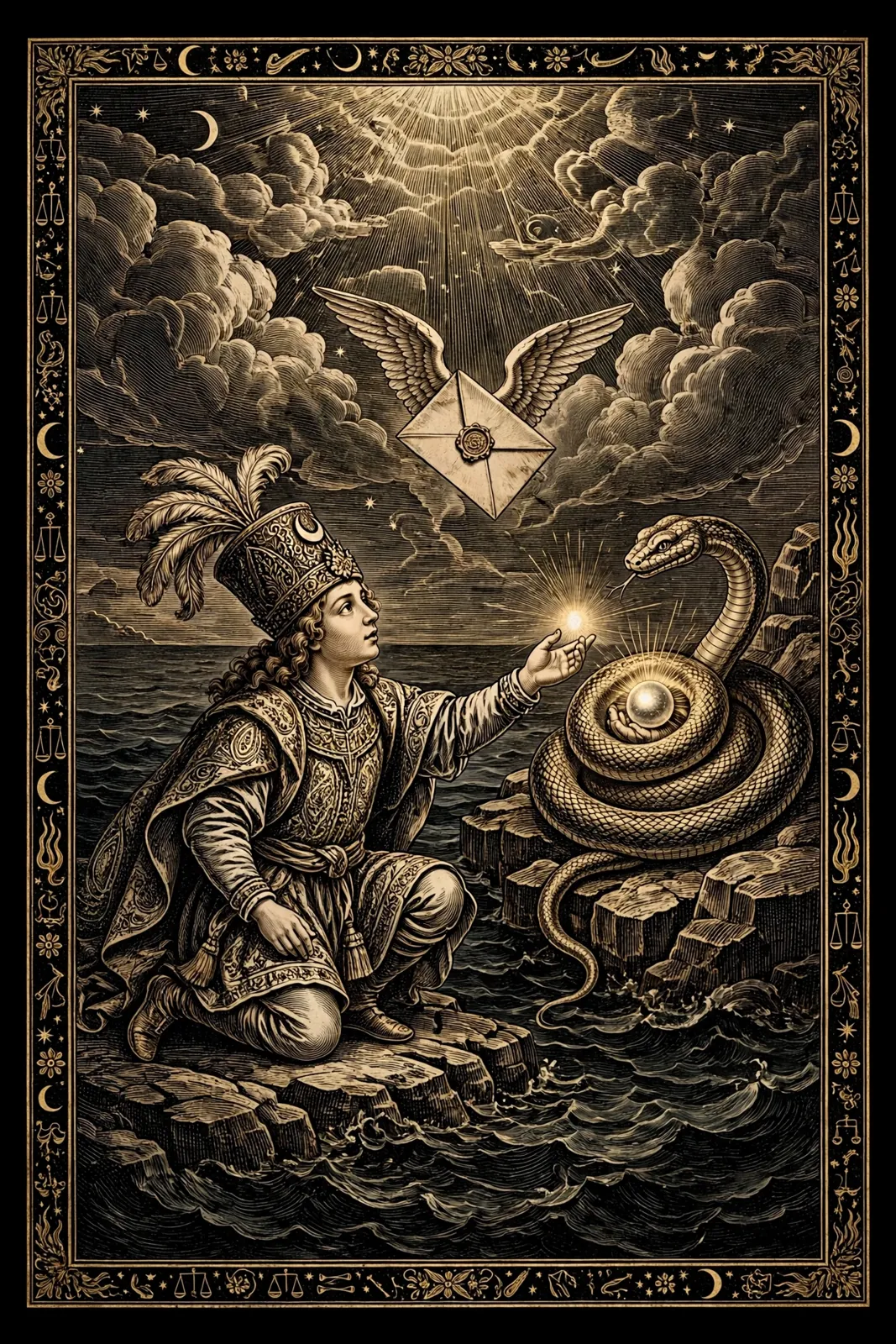
Engraving in gold on black: a young prince in ornate Persian dress kneels on rocks by a dark sea and reaches toward a glowing pearl held in the coils of a great serpent, while a winged letter descends toward him from a radiant sky
Plate V · The Pearl A modern engraving in the antique style, drawn for this guide: the king’s son in the Hymn of the Pearl reaches for the pearl in the serpent’s coils as his father’s letter flies down to wake him — the whole Gnostic story told as a fairy tale, and retold in the cards below.

Norea burns the ark

Hypostasis of the Archons. Noah, serving the archons in this telling, refuses to let Norea aboard the ark. She breathes fire on it and burns it — Noah has to build it again. When the archons later come to seize her, she cries out to the true God and the angel Eleleth descends, scatters them, and teaches her the whole truth about her root. It is one of the very few ancient texts where a woman demands revelation — and receives it directly, over the heads of the men.

The laughing Saviour

Second Treatise of the Great Seth and Basilides via Irenaeus. At the crucifixion, the true Christ does not suffer: in one version Simon of Cyrene is transformed to look like Jesus and is crucified in his place while Jesus, unseen, laughs at the archons' mistake; in another, Christ exchanges forms and stands by. Orthodox readers found this monstrous. In the logic of the myth it is consistent — the archons can only seize matter, and the Saviour was never truly theirs to kill.

Thunder: Perfect Mind

Nag Hammadi Codex VI. No plot at all — a divine female voice speaking in pure paradox: “I am the first and the last. I am the honoured one and the scorned one. I am the whore and the holy one. I am the wife and the virgin… I am the silence that is incomprehensible.” Scholars still argue who is speaking — a fallen-and-restored Sophia figure, Eve, or a goddess like Isis in Gnostic dress. It is the most quoted poem in the library, and the hardest to file under any school.

The soul as a fallen woman who comes home

Exegesis on the Soul. The soul is told as a woman who left her father's house, fell among robbers and lovers who used and abandoned her, and — diseased, lonely, and ashamed — finally cries out. The Father hears, sends her true bridegroom (her brother, in the allegory's strange logic — her heavenly counterpart), and her womb, which had “turned outward,” turns inward and is made new. A retelling of the prodigal son, with the genders reversed and the repentance made bodily.

The Hymn of the Pearl

Acts of Thomas (Syriac, not Nag Hammadi — but the most beloved Gnostic story ever told). A king's son is sent to Egypt to retrieve a pearl guarded by a serpent. There he eats the Egyptians' food, forgets he is a king's son, and sleeps. A letter from his father flies to him like an eagle — “Awake and arise from your sleep, and hear the words of our letter” — and he remembers, charms the serpent, takes the pearl, and puts on his robe of glory on the road home. Jungians, poets, and Gnostics all claim it: it is the whole system in one fairy tale — descent, forgetting, a message, awakening, return.

Jesus and the angry apostles

Gospel of Mary. After the resurrection, the apostles are weeping and terrified of suffering as Jesus did. Mary Magdalene stands up, steadies them, and recounts a vision of the soul rising past powers that challenge it — Wrath, Darkness, Desire, Ignorance — each answered with knowledge of its own origin. Andrew doubts it; Peter asks, in effect, whether Jesus really spoke privately with a woman over them. Levi ends the argument: the Saviour knew her completely and loved her more than them — “rather, let us be ashamed… and preach the gospel, without laying down any other rule.” The text breaks off with them going out to preach.

Mary questions Jesus in Pistis Sophia

Pistis Sophia (Askew Codex). For eleven years after the resurrection, Jesus teaches the disciples on the Mount of Olives about Sophia's fall through thirteen repentances — psalm-like songs of a power trapped in chaos, crying to the Light. Mary Magdalene asks the majority of the questions and interprets the scriptures, to Peter's open complaint that “we cannot endure this woman.” However later and stranger this text is, its centre is unmistakable: a fallen female power who will not stop repenting until she is heard.

Adam teaches Seth before he dies

Apocalypse of Adam. The aged Adam, about to die, tells his son Seth what he learned from three heavenly visitors: that he and Eve once stood in glory greater than the god who made them, that this god divided them and dimmed that glory out of jealousy, and that a chosen illuminator will come whom the earthly powers will try — and fail — to destroy. It is a testament, a prophecy, and a warning in one: the archons will win every battle except the one that matters.

Section 7

Why it was labeled heresy — and suppressed

Hairesis (αἵρεσις) originally meant “choice” or “school of thought” — a neutral word. In Christian use it came to mean a choice against the church’s public teaching. The crucial point: in the 2nd century there was no settled orthodoxy to deviate from. The label “heresy” was itself part of the process by which orthodoxy was being constructed. The Gnostics mostly did not see themselves as leaving Christianity — Valentinus and his pupils saw themselves as the spiritual Christians within the larger body. It was the proto-orthodox party that defined them out.

Why the church said no — at a glance

Five disagreements did most of the work. Everything else — the books, the creeds, the bishops, eventually the laws — was built to hold these five lines:

  1. Who made the world? Gnostics: a lesser, ignorant god. Church: the highest God himself — and what he made is good.
  2. Who is Jesus? Gnostics (in many schools): a messenger from beyond this world who only seemed to be flesh, or who left his body before it died. Church: truly God, truly human, truly born, truly crucified.
  3. What is wrong with us? Gnostics: ignorance — we have forgotten where we came from. Church: sin — a moral rebellion that needs forgiveness, not just information.
  4. Who can be saved, and how? Gnostics: those who receive gnosis — in the strict systems, only those born carrying the spark. Church: salvation is preached openly to everyone who believes.
  5. Whose scripture counts? Gnostics: secret revelations and new gospels, passed hand to hand from hidden apostolic teachers. Church: the public tradition of the churches — the Old Testament kept, four Gospels, the apostles' teaching guarded by bishops in open succession.

There was also a power question underneath the theology, and both sides knew it. A teacher with a secret revelation answers to no bishop. A bishop with a creed and a canon can say a teacher is wrong — and be obeyed. The fight over Gnosticism was a fight over who gets to define Christianity, conducted at a moment when the definition did not yet exist.

The theological charges

  1. One God, Creator and Redeemer. Gnostics split God into a hidden Father and an inferior creator, demoting the Old Testament God to Demiurge. The church affirmed one God, “Maker of heaven and earth,” and that “everything God created is good” (Gen 1:31; 1 Tim 4:4).
  2. The incarnation. Docetism and separationism denied the Word truly became flesh, was born, and suffered. The church answered with Jesus’ bodily reality — tired, weeping, bleeding, inviting Thomas to touch his wounds — and with 1 John 4:2 as a test.
  3. The bodily resurrection. Gnostics reinterpreted resurrection as present spiritual awakening; the church affirmed a future resurrection of the body, confessed in the creeds.
  4. Salvation offered openly to all. Gnosis belonged by definition to those who possessed the spark and received the secret tradition; the church insisted salvation is offered to all who believe.
  5. Sin as moral rebellion, not ignorance. For the church, evil entered through creatures’ rebellion and sin is a moral offence; for the Gnostics, the problem was ignorance and entrapment — and the creator himself was the problem.

To these were added social charges: claims of continuing revelation and new scripture; appeals to secret apostolic traditions (Theudas from Paul, Glaucias from Peter, Matthias, James, Thomas, Mary Magdalene) against the churches’ public teaching; and asceticism — and, in the Fathers’ reports, libertinism — flouting the church’s moral discipline.

Irenaeus of Lyon (c. 130 – c. 202)

Irenaeus is the single most important figure in the suppression — and, paradoxically, the single most important source for what was suppressed. Born in Asia Minor, where as a boy he heard Polycarp preach, he became bishop of Lugdunum (Lyon) and is first mentioned as a priest there in 177 CE, during the persecution under Marcus Aurelius. The spread of Gnosticism in Gaul inspired his great work.

Adversus haereses — Against Heresies, its Greek title quoting 1 Tim 6:20: Detection and Overthrow of the Knowledge Falsely So-Called — was written c. 180–185 (some date the five books 180–199) and survives complete only in a literal Latin translation made as early as c. 200.

Book IDescription — the sects’ teachings in detail, above all Valentinus and Ptolemy, traced back through Basilides, Marcion, and Simon Magus. Irenaeus’s view: simply to state the doctrines is to show their absurdity.
Book IIRefutation by logic — Valentinianism shown to be inwardly inconsistent and absurd.
Book IIIRefutation from tradition and Scripture — the unity of God, creation, and the incarnation, against docetic denial.
Book IVThe unity of the Old and New Testaments, against Marcionite and Gnostic rejection of the Old.
Book VEschatology — above all the resurrection of the body, “so offensive to the Gnostic spiritualism,” plus the Antichrist and the millennium.

Irenaeus’s positive argument outlived the polemic: the appeal to public, apostolic tradition against secret tradition. If the apostles had known hidden mysteries, he reasoned, they would have entrusted them to the leaders of the churches they founded. He listed the succession of bishops at Rome, summarised the apostolic faith in a “rule of truth” (one God, Maker of heaven and earth; one Christ Jesus, incarnate for our salvation; the Holy Spirit speaking through the prophets — a template for the later creeds), and defended the fourfold Gospel: four Gospels, no more and no fewer. His argument — four because there are four zones of the world and four principal winds — shows how contested the point still was. An older Catholic account claims the work “dealt a death-blow to gnosticism”; that overstates it (Gnostic groups survived for centuries), but even after Nag Hammadi, Against Heresies remains a primary source, since most Gnostic writings are still lost.

The other heresiologists

  • Justin Martyr (c. 100–165): a lost Syntagma against all heresies (c. 150); his First Apology criticises Simon, Menander, and Marcion.
  • Tertullian of Carthage (c. 155 – c. 230): Against the Valentinians (c. 206) and five books Against Marcion (c. 207–208) — our fullest source for Marcion’s gospel and canon.
  • Hippolytus of Rome (170–235): the ten-volume Refutation of All Heresies, reporting on 33 groups modern scholars consider Gnostic — and making little effort, in places, to record them accurately. A standing caution.
  • Clement of Alexandria and Origen: the ambivalent ones. Clement used gnostikos approvingly of the mature Christian and preserved the Excerpts of Theodotus; Origen quoted Heracleon at length in order to answer him.
  • Epiphanius of Salamis (c. 310–403): the Panarion (c. 375), cataloguing some eighty heresies; he still knew Gnostic sects personally and preserves Ptolemy’s Letter to Flora in full.

From argument to coercion: canon, creed, empire

  • Canon. Marcion’s shortened canon and the many Gnostic gospels pressed the churches to identify the apostolic writings. By the late 2nd century Irenaeus could speak of four Gospels; the Old Testament was kept as the Scripture of the one God. The first surviving list matching the 27-book New Testament exactly is Athanasius’s Festal Letter of 367 CE — which also forbade owning other books.
  • Creed and episcopate. The “rule of truth” hardened into baptismal creeds; the monarchic episcopate — one bishop per city, in apostolic succession — became the guarantee of true teaching against private revelation.
  • Imperial power. In the 4th century, with Christianity the religion of the Empire, possessing heretical books became a criminal offence. Constantine ordered Arius’s books burned and made possession a capital offence; the Theodosian Code preserves law after law confiscating property, banning assemblies, destroying texts. By the century’s end, “the evolving ecclesia had added the force of political correctness to dogmatic denunciation, and with this sword so-called ‘heresy’ was painfully cut from the Christian body” (Gnosis Archive).
Two correctives to the popular story. First, Nicaea did not vote on the canon or burn the Gnostic gospels — the canon was not on its agenda in 325, and the four-gospel canon was already old by then. Second, the decline was not only coercion: Gnosticism’s appeal depended on a particular intellectual climate, its groups were loosely organised around individual teachers, and by the 3rd century they were already declining as the Empire’s economy and culture deteriorated — conditions that hurt small teacher-centred circles more than an organised church.

Section 8

Is “Gnosticism” even a useful category?

This is the liveliest part of the field, and the honest answer is that scholars disagree — and the disagreement is itself the most important recent development. The Nag Hammadi texts were expected to confirm the category; instead, as Karen King writes, they “only exacerbated [the definitional crisis] by multiplying further the already wide variety of phenomena categorized as Gnostic.” The Gospel of Thomas has no Demiurge; the Gospel of Truth has no aeon myth; the Thunder: Perfect Mind has no narrative at all.

Late 19th century

Harnack: a Christian heresy

Adolf von Harnack defines Gnosticism as “the acute Hellenization of Christianity” — to be understood through the history of dogma, as a corruption arising inside the church.

1934–1958

Hans Jonas: the existential synthesis

In The Gnostic Religion (1958), Jonas reads Gnosticism as an existential condition of alienation — the soul “thrown” into a hostile world (Heidegger’s geworfenheit) after Alexander’s conquests dissolved the old orders. His typology — Syrian-Egyptian (more monist) versus Persian (more dualist) currents — is still widely used. His critics say he made Gnosticism too central, turning diverse movements into a timeless mood.

April 1966

The Messina conference: a truce that failed

An international colloquium at Messina, Italy, proposes a terminological truce: capital-G “Gnosticism” for the specific 2nd-century systems attacked by the Fathers; lower-case gnosis for the broader phenomenon of salvific knowledge. The definition is now generally regarded as abandoned — the Brill survey notes it “created a religion, ‘Gnosticism,’ from the ‘gnosis’ which was a widespread element of ancient religions,” while excluding the Mandaeans and Manichaeans. King’s verdict: “By including everything, nothing was decided.”

1996

Williams: dismantle the category

Michael Allen Williams, Rethinking “Gnosticism”: the category’s foundations are “the remains of the agenda of the heresiologists.” The stereotypes — world-hating, body-despising, alienated souls who believed themselves a superior spiritual race — had never been tested against the recovered texts, and testing them shows how dubious they are. His proposed replacement, “the Biblical demiurgical tradition,” has not become widely used.

2003

King: it never named a real thing

Karen L. King, What Is Gnosticism? — a book that, as one summary puts it, “does not answer its titular question. That is its central achievement.” Her argument: “There was and is no such thing as Gnosticism, if we mean by that some kind of ancient religious entity with a single origin and a distinct set of characteristics.” The term is a rhetorical artefact — generated by ancient polemicists who needed a heretical other to stabilise orthodoxy’s boundaries, then reified by modern scholarship. Scholars, she argues, have “unwittingly continued the project of ancient heresiologists.”

Fall 2014

Westar’s Christianity Seminar votes “dismantle”

With at least twenty-five internationally known scholars attending, the seminar concludes “the category of gnosticism needs to be dismantled” — voted “Red,” meaning no doubts. Its argument: no group possesses all the usually attributed features; nearly every group possesses one or more; and there was no particular relationship among any set of groups that could be distinguished as “Gnostic” in opposition to some other set.

2021

Thomassen: keep it — as a school of thought

Einar Thomassen, The Coherence of “Gnosticism,” argues the category survives if understood as a “Gnostic school of thought” — a recognisable cluster of myths, rituals, and anthropologies concentrated in the 2nd–3rd-century eastern Mediterranean — rather than a single religion or social entity. Bentley Layton takes the restriction route: reserve “classical Gnostic” for the Sethians and Ophites and the myth of the Apocryphon of John, treating Valentinianism as related but distinct and Thomas as not Gnostic at all. Meanwhile, as the Brill survey notes, “Gnostic studies” has often simply become “Nag Hammadi studies” — organised by text and tradition rather than by a master category.

Where this leaves the reader: “Gnosticism” is a useful shorthand for a family resemblance among 2nd–3rd-century movements — the Demiurge myth, the divine spark, salvation by gnosis — and a misleading proper noun if taken to name a single ancient church with a founder, a creed, and a membership list. This page uses it in the shorthand sense, and names the specific movement wherever the distinction matters.

Other live disputes, in brief

  • The Gospel of Thomas: early wisdom gospel (Koester) or 2nd-century mystical redaction (DeConick, Meier)? Gnostic, or not at all?
  • The Gospel of Truth: by Valentinus himself, or by a disciple?
  • Basilides: which heresiologist, Irenaeus or Hippolytus, preserves the real system — or is neither reliable?
  • Sethian origins: inner-Jewish or heterodox Christian? A real movement, or a set of mythological themes (van den Broek)?
  • The Cathars: direct descent from ancient Gnosticism via the Bogomils, or an independent medieval dualism given an old label?
  • Mandaean origins: Judean or southwestern Mesopotamian? Pre-Christian or post-Christian?
  • Bauer’s thesis: was “heresy” the original form of Christianity in many regions, with orthodoxy a later Roman imposition? Influential, much criticised, still debated.

Section 9

Lasting influence: religion, philosophy, culture

Mandaeism — the one that survives

The Mandaeans are the one ancient Gnostic religion still living. Their very name carries the idea: manda is Aramaic for “knowledge” — an exact translation of gnosis. They revere Adam, Seth, Noah, and above all John the Baptist, their greatest and final teacher; they practise repeated baptism (masbuta) for the soul’s redemption; the World of Light is ruled by Hayyi Rabbi (“The Great Life”), while the material world — a mixture of light and dark — was made by Ptahil, who fills the Demiurge’s role. Their chief scripture is the Ginza Rabba (“Great Treasure”), portions dated by some scholars to the 2nd–3rd centuries. There are thought to be 60,000–70,000 Mandaeans worldwide, in southern Iraq and Khuzestan (Iran) and in diaspora communities across North America, Western Europe, and Australia. Jorunn Buckley argues they “may well have become the inventors of — or at least contributors to the development of — Gnosticism,” and produced the most voluminous Gnostic literature we know.

Manichaeism — the world religion

Founded by the Persian prophet Mani (216–276) — raised among the Elkesaites, a Jewish-Christian baptising sect — Manichaeism took up cosmic dualism and the entrapped particles of light and became a major movement that briefly rivalled Christianity: two realms, light and darkness, fell into conflict; creation exists to extract the trapped light; in the end, light prevails. It spread from Mesopotamia to North Africa and China, becoming the state religion of the Uyghur Khaganate in 762, and remained influential in China until the late 9th century. Augustine was a Manichaean “hearer” for about nine years before his conversion. Whether Manichaeism is “Gnostic” or a distinct, later, more rigidly dualistic religion that absorbed Gnostic ideas is debated; most scholars treat it as the latter.

Medieval echoes — with a caution

Dualist ideas resurfaced in the Paulicians (Armenia, 650–872), accused of Gnostic and quasi-Manichaean beliefs; the Bogomils (Bulgaria, from 927–970), who spread Paulician ideas across Europe; and the Cathars of southern France, suppressed in the Albigensian Crusade (1209–1229), whose enemies accused them of worshipping a lesser, Satanic creator. Whether the Cathars descend historically from ancient Gnosticism is disputed — they apparently placed no special weight on gnosis itself, so the continuity is one of dualist cosmology, not of Gnostic salvation. Similar caution applies to Gnostic influence on Kabbalah (Scholem argued for it; the Cathar–Kabbalah link has not been substantiated by any extant text) and to Yezidism, sometimes claimed as a continuation of Sethianism — a claim noted here, not endorsed.

The 19th-century revival

The first Gnostic texts to reach a modern public were the Pistis Sophia and the Books of Jeu; from 1896, G. R. S. Mead’s translation of the Pistis Sophia made a complete Gnostic mythology available to any reader. The Theosophical Society of Helena Blavatsky revived Gnostic ideas; in 1890 Jules Doinel “re-established” a Gnostic church in France, whose successors continue today. Schopenhauer, Albert Pike, and Blavatsky studied Gnostic thought extensively; Melville and Yeats were tangentially influenced.

Jung and psychology

Carl Gustav Jung is Gnosticism’s most consequential modern reader. Interested from at latest 1912 (in an enthusiastic letter to Freud), he found in Gnosticism — and in alchemy, its continuation — external evidence for his “encounter with the unconscious.” In the winter of 1916–17 he wrote the Septem Sermones ad Mortuos, a Gnostic pastiche attributed to Basilides. Jung read the Demiurge psychologically as the ego that has forgotten its origin in the greater Self, and the drama of fall and return as individuation — the reintegration of the self, like the spark’s reunion with God. Philip Jenkins argues the Gnostic grammar of sleep, forgetting, amnesia, and recovery-as-liberation now underlies many forms of contemporary therapy. And one Nag Hammadi codex still bears his name: the Jung Codex.

Philosophy, literature, popular culture

Hans Jonas made Gnosticism a diagnosis of modernity, drawing close parallels with existentialism. Eric Voegelin (1952) argued “the essence of modernity is the growth of Gnosticism,” counting progressivism, communism, fascism, and psychoanalysis as Gnostic — a polemical use that says more about Voegelin than antiquity, but one that made the term central to 20th-century conservative thought. Harold Bloom argued the American religion is at bottom Gnostic. In literature: Borges wove Gnostic motifs through his stories; Hesse and Camus and Ginsberg were moderately influenced; Philip K. Dick — above all VALIS (1981) — heavily. Star Wars (1977), Harry Potter (1997), and The Matrix (1999) have all been described as embodying Gnostic structures: a hidden true reality, a false world kept by malign powers, awakening as salvation. Scientology offers, in Jenkins’s phrase, “an unabashedly Gnostic mythology of sleep, forgetting, and reawakening.” Modern Gnostic churches — the Ecclesia Gnostica, the Apostolic Johannite Church, and others — are post-war revivals, not continuations of ancient congregations; with the Mandaeans excepted, no ancient Gnostic community survives.

The influence that runs the other way

The deepest influence is the least visible: orthodox Christianity was shaped by the fight against Gnosticism. The canon (four Gospels, the Old Testament kept), the creeds (one God, Maker of heaven and earth; Christ born, suffered, crucified; resurrection of the body), the monarchic episcopate, and the doctrine of creation as good were all formulated, in part, as answers to Gnostic challenges. As the Gnosis Archive puts it, “formulations of many central traditions in Christian theology came as reflections and shadows of this confrontation with the Gnosis.” Gnosticism lost the institutional battle — and, in losing, helped define what won.

Reference

Definitions: a Gnostic glossary

Every key term on this page, in one place, in plain language. Greek is given where the Greek is doing real work. Keep this open while reading the story — the vocabulary is half the subject.

Aeon aiōn
A divine being or power emanated from the highest God, living in the Pleroma. Also means “an age” or eternity — an aeon is a person and a timescale at once.
Apocryphon
A “secret book” — a text claiming hidden revelation, usually in dialogue between a risen revealer and a disciple. Apocryphon of John = “The Secret Book of John.”
Archon archōn, “ruler”
A subordinate power serving the Demiurge, ruling a heaven or planet and guarding the soul's ascent after death.
Bridal chamber
The highest Valentinian sacrament: the symbolic (or visionary) reunion of the soul with its heavenly counterpart — its lost other half.
Codex plural: codices
An ancient book of bound pages, as opposed to a scroll. The Nag Hammadi find was 13 codices.
Demiurge dēmiourgos, “craftsman”
The maker of the material world. Benevolent in Plato; ignorant, flawed, or evil in Gnostic systems. See Yaldabaoth.
Docetism from dokein, “to seem”
The teaching that Christ only seemed to have a real body and to suffer and die.
Dualism
Any system built on two opposed principles. Radical: two co-equal eternal powers. Mitigated: one is lesser. Valentinianism is arguably neither — see “qualified monism.”
Emanation
How the divine world is produced: by overflow from the One, like light from a source, in descending grades — not by creation out of nothing.
Epinoia
“Afterthought” / inventive reflection — in the Apocryphon of John, the Epinoia of Light is the divine helper hidden in Adam, embodied in Eve, who wakes humanity.
Five Seals
The Sethian baptismal / ascent rite — five immersions or anointings with invocations, sealing the soul for its journey past the archons.
Gnosis gnōsis, “knowledge”
Saving knowledge by direct experience — knowing where you came from, who made this world, and how to get home. Not information about God; participation in the divine.
Heimarmenē
Fate — the archons' machinery of stars, planets, and necessity that keeps souls bound and forgetful.
Heresiologist
A church writer who catalogued and refuted “heresies” — Irenaeus, Hippolytus, Epiphanius. For 1,800 years, our main (hostile) source for Gnostic teaching.
Hylic / Psychic / Pneumatic
The three Valentinian classes of humanity: hylikoi (material — bound to matter), psychikoi (soulish — ordinary believers, capable of a lesser salvation), pneumatikoi (spiritual — carriers of the spark).
Kenoma
The “emptiness” or deficiency — the lower world outside the Pleroma, where matter and ignorance rule. The opposite of Fullness.
Logos
“Word” / reason — a divine aeon and mediator in many systems, inherited from Philo, Plato, and John's Gospel.
Monad
The One — the highest, unknowable God. The single source from which all emanation flows.
Pleroma plērōma, “Fullness”
The totality of the divine world: the Monad together with all the aeons. Perfection, completeness, home.
Pneuma / Psyche / Hylē
Spirit / soul / matter — the three substances. A human being may hold all three; which one dominates decides their class and fate.
Separationism
The teaching that the heavenly Christ and the human Jesus are distinct: Christ descended on Jesus at baptism and departed before the crucifixion.
Spark / Seed
The fragment of divine light trapped in (some) human bodies — also called the seed, the pearl, the inner self. Gnosis wakes it; death releases it.
Syzygy
A pair — aeons exist in male–female couples. Creation done alone, without one's syzygy, is how Sophia's error happens.
Yaldabaoth
The Demiurge's proper name in Sethian texts. Lion-faced, serpent-bodied chief archon who boasts he is the only God. Also called Saklas and Samael.
A note on names: spelling varies by translation — Ialdabaoth / Yaldabaoth, Abrasax / Abraxas, Barbelo / Barbēlō. These are Greek and Coptic renderings of names that were already foreign in antiquity; the variation is in the sources, not an error.

Appendix

Unresolved Questions

Ancient evidence is fragmentary, and scholars often disagree. These questions invite further reading rather than a single definitive answer.

  • Dating and authorship of most Nag Hammadi texts. Greek originals are proposed at 1st–2nd century, composition more often placed 2nd–3rd century, manuscripts 3rd–4th century; the Gospel of Thomas alone is dated anywhere from the mid-1st to the mid-2nd century. No consensus exists.
  • Basilides’ actual teaching. Irenaeus and Hippolytus contradict each other, and only fragments attributed to Basilides survive in later quotations.
  • Why the codices were buried. The Athanasius-367 suppression hypothesis and the funerary-deposit hypothesis both fit some evidence; neither is proven.
  • Marcionism’s end date. Sources disagree between the 5th and the 10th century; the organised movement certainly outlived the other Gnostic schools by centuries.
  • The Cathars’ descent from ancient Gnosticism. Direct historical influence is disputed; the similarity may be parallel dualism rather than transmission.
  • The Gospel of Philip kiss. The key word is missing from the manuscript; “on the mouth” is a reconstruction, not a reading.
  • Yezidism as a continuation of Sethianism/Ophitism. Noted in some surveys, contested, and not endorsed in the underlying research.
  • Whether “Gnosticism” should be retained as a category at all. A live debate, not a settled fact — see Section 8.

Appendix

Sources

Researched 15 November 2026. Use the ancient texts to explore the teachings directly, and the modern scholarship to compare interpretations. These sources differ in perspective: reference works, devotional archives, confessional resources, and academic studies should be read in context.

Reference works & introductions

  1. Encyclopaedia Britannica, “Gnosticism” — britannica.com/topic/gnosticism
  2. The Gnosis Archive, “An Introduction to Gnosticism and the Nag Hammadi Library” — gnosis.org/naghamm/nhlintro.html
  3. BiblicalTraining Library, “Gnosticism” — biblicaltraining.org/library/gnosticism
  4. BiblicalTraining Library, “Valentinus” — biblicaltraining.org/library/valentinus
  5. BiblicalTraining Library, “Marcion” — biblicaltraining.org/library/marcion

Reference syntheses & scholarship

  1. Wikipedia, “Gnosticism” — en.wikipedia.org/wiki/Gnosticism
  2. Wikipedia, “Nag Hammadi library” — en.wikipedia.org/wiki/Nag_Hammadi_library
  3. Wikipedia, “Coptic Gospel of Thomas” — en.wikipedia.org/wiki/Coptic_Gospel_of_Thomas
  4. Wikipedia, “Marcion” and “Marcionites” — en.wikipedia.org/wiki/Marcion · en.wikipedia.org/wiki/Marcionites
  5. Wikipedia, “Gnosticism in modern times” (Neo-Gnosticism) — en.wikipedia.org/wiki/Neo-Gnosticism
  6. Einar Thomassen, The Coherence of “Gnosticism” (2021), via Perlego — perlego.com/book/2108167/the-coherence-of-gnosticism-pdf
  7. Brill, The Dead Sea Scrolls and the Nag Hammadi Codices, ch. 1 — brill.com/display/book/9789004517561/BP000012.xml
  8. “Gnosticism as a Potentially Flawed Category” (Primidi summary) — primidi.com/gnosticism/gnosticism_as_a_potentially_flawed_category
  9. Princeton University, “Elaine Pagels” — dof.princeton.edu/people/elaine-pagels
  10. Catholic Culture, “Church Fathers: St. Irenaeus of Lyons, Part I” — catholicculture.org/commentary/church-fathers-st-irenaeus-lyons-part-i
  11. Modern Age, “Gnosticism” — modernagejournal.com/gnosticism/249694
  12. Philip Jenkins, “The Heresy that Wouldn’t Die” — lionandlambapologetics.org — Jenkins, “The Heresy that Wouldn’t Die” (PDF)
  13. The Gospel of Thomas, Patterson & Robinson translation (Gnosis Archive) — gnosis.org/naghamm/gth_pat_rob.htm

Books cited

  • James M. Robinson (ed.), The Nag Hammadi Library in English (1977; rev. 1988)
  • Elaine Pagels, The Gnostic Gospels (1979); Beyond Belief: The Secret Gospel of Thomas (2003)
  • Hans Jonas, The Gnostic Religion (1958); Gnosis und spätantiker Geist (1934–54)
  • Michael Allen Williams, Rethinking “Gnosticism” (Princeton, 1996)
  • Karen L. King, What Is Gnosticism? (Harvard, 2003)
  • Kurt Rudolph, Gnosis: The Nature and History of Gnosticism (1983)
  • Bentley Layton, The Gnostic Scriptures (1987)
  • Nicola Denzey Lewis, Introduction to “Gnosticism” (Oxford, 2013)
  • Geoffrey S. Smith, Valentinian Christianity: Texts and Translations (California, 2020)
  • John D. Turner, Sethian Gnosticism and the Platonic Tradition (2001)

Image: Nag Hammadi Codex II, pages of the Apocryphon of John — public-domain photograph via Wikimedia Commons; the manuscript is held by the Coptic Museum, Cairo. The Ouroboros, Abraxas, and Serpent engravings, and the Sophia, emanation-diagram, moonlit-ruins, ascent, jar, and pearl plates, are modern illustrations in the antique style, made for this guide.

“The soul seeks not to believe, but to know — and in knowing, to return.”